
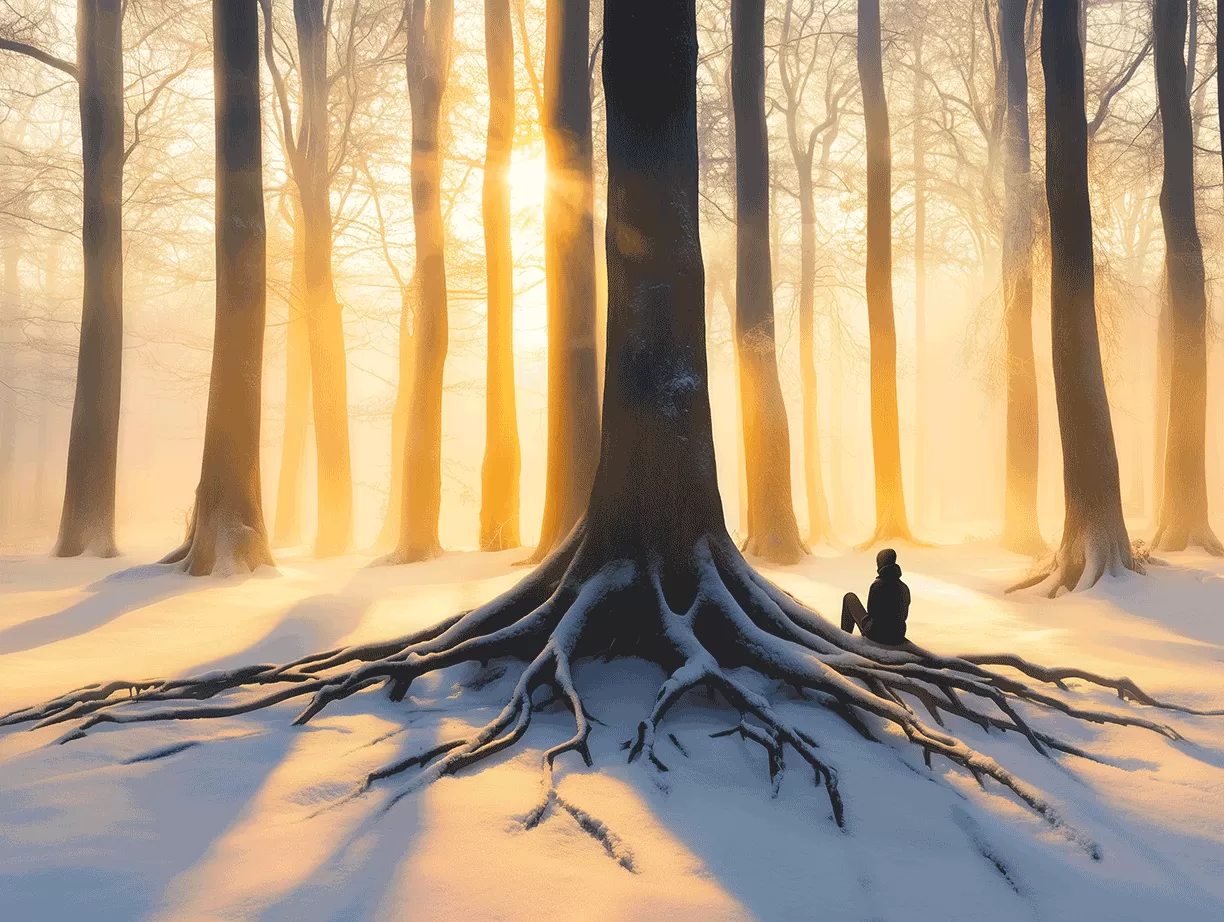
The Inner Winter: How Reflection and Contemplation Build Your Mental and Spiritual Strength
The Craft of Deep Listening
Every morning for a year, I sat with the same chapter of the Tao Te Ching. Not reading it once and moving on—transcribing it. Six different translations, side by side, watching how Mitchell’s “The Tao that can be spoken is not the eternal Tao” becomes Feng and English’s “The Tao that can be told is not the eternal Tao.”
The ritual taught me something our information-saturated age has forgotten: the difference between consuming wisdom and digesting it.
In our culture of infinite scroll and instant expertise, we’ve lost the art of what Katherine May calls “wintering”—those necessary seasons of turning inward, slowing down, and allowing life’s deeper currents to surface. We mistake busyness for purpose, stimulation for nourishment, networking for connection.
But just as forests require fallow periods, human consciousness needs seasons of centering. This isn’t escape from engagement—it’s preparation for authentic presence in the world.
What Reflection and Contemplation Actually Are
Beyond Productivity Culture’s Inner Work
The contemplative life has been colonized by our optimization obsession. We download meditation apps to enhance performance. We practice mindfulness to increase focus. We approach inner work like any efficiency project—inputs, outputs, measurable results.
Philosopher Byung-Chul Han warns that our “compulsion of production” has infected even our most sacred practices. When we treat contemplation as self-improvement, we miss its transformative potential entirely.
True reflection involves intellectual engagement with our thoughts, experiences, and reality. It’s the practice of examining life—what the Islamic tradition calls muḥāsabah, or self-accounting. We consider our positions, question assumptions, trace connections between inner experience and outer reality.
Contemplation moves deeper. It’s holistic spiritual awareness that engages mind, body, and spirit in recognizing what Thomas Merton called “the highest expression of our intellectual and spiritual life”—being “fully awake, fully active, fully aware that it is alive.”
Katherine May’s “wintering” provides a powerful metaphor for this inner work. Wintering isn’t depression or withdrawal—it’s strategic centering. It’s recognizing that life moves in cycles, and our most difficult seasons often prepare us for authentic growth.
The Solitude-Community Paradox
Why Deep Practice Requires Both Centering Solitude and Collective Engagement
Modern culture presents a false choice: either spiritual solitude or community engagement, either inner work or outer service, either contemplation or action.
The wisdom traditions know better. Authentic community flows from individual depth, and genuine solitude prepares us for deeper connection with others.
My Tao Te Ching practice illustrates this paradox. The solitary morning hours appeared purely individual but were rooted in community wisdom. Lectio divina emerged from centuries of monastic experience. The Tao Te Ching itself represents distilled insights of countless practitioners.
Katherine May’s exploration of wintering reveals how individual seasons of difficulty strengthen our capacity for authentic community presence. Those who learn to navigate their own inner winters become guides for others facing similar terrain.
Inner work as foundation for outer engagement prevents us from using relationships to avoid ourselves. When we haven’t developed inner resources for dealing with uncertainty or conflict, we unconsciously burden others with our unprocessed material. Community becomes a place to project shadows rather than share gifts.
Contemplative practice develops what Merton called the “Light Within”—a source of wisdom that becomes “workaday light for the marketplace.” The depth we discover in solitude naturally wants to express itself in service.
Community as crucible for individual growth keeps contemplative practice from becoming narcissistic navel-gazing. Others reveal our blind spots, challenge self-deceptions, and provide opportunities to practice patience and forgiveness in real time.
The monastery model demonstrates this integration. Monks pursue extreme solitude within strong community structures. They need the hermitage for depth and brotherhood for accountability. Neither alone produces mature spiritual development.
The integration challenge involves moving beyond alternation—centering then engaging—toward what contemplatives call “simultaneity.” We learn to maintain contemplative awareness within daily interactions, carrying reflection’s fruits into work and relationships.
Han describes “community without communication”—connection through symbolic recognition rather than constant information exchange. Two people who have done serious inner work can recognize each other without words, support each other without explanation.
Building Your Contemplative Capacity
The Training Ground of Daily Practice
Think of contemplative practice as developing spiritual muscle. Just as physical training strengthens specific capacities, contemplative training builds precise inner capabilities.
Attentional control forms the foundation. This isn’t about emptying the mind but training sustained, intentional awareness. In our scattered-attention age, the ability to focus deeply becomes revolutionary. We learn to anchor attention deliberately, notice when it wanders, return it gently to our chosen focus.
Self-awareness emerges through patient observation. The practice of muḥāsabah involves watching ourselves with the curiosity of a naturalist. We notice patterns: the stories we tell ourselves, triggers that activate defenses, subtle ways we avoid difficulty.
This observation reveals the difference between thoughts and thinker, emotions and the one experiencing them. We discover “decentering”—the capacity to step back from immediate experience and recognize it as one movement in a larger dance.
Emotional regulation follows naturally. When we’re no longer completely identified with our emotional states, we can respond more skillfully. Anger becomes information rather than compulsion. Sadness becomes invitation rather than defeat.
My year with the Tao Te Ching developed these capacities in ways no amount of reading about them could have. Daily transcription cultivated contemplative patience. Translation comparison trained discernment. Lectio divina reflection that followed taught the art of sitting with questions rather than rushing toward answers.
Practical Training Methods
Attentional practices begin with focused concentration. Choose a text that speaks to your deepest questions—poetry, philosophy, even fiction. Read slowly, repeatedly, allowing words to resonate beyond their conceptual meaning. Notice what emotions arise, what memories surface, what questions emerge.
Non-judgmental observation forms the core of contemplative training. Buddhist mindfulness teaches us to notice thoughts and emotions without immediately categorizing them as good or bad. Daoist “sitting and forgetting” involves releasing our need to control inner experience.
The art lies in learning to “sit with” difficult questions rather than solving them prematurely. When we encounter uncertainty or contradiction, contemplative practice invites us to remain present with not-knowing.
Creating inner sanctuary requires both structure and spontaneity. Establish regular rhythms—daily reflection time, weekly deeper practice, seasonal retreats from busyness. But also learn to access contemplative awareness within ordinary activities.
Han writes about “the art of lingering”—allowing unproductive time for symbolic recognition and deeper formation. In our efficiency-obsessed culture, this becomes radical: spaces for what appears to be doing nothing but involves the deepest work of all.
Finding Your Winter Space
Creating Conditions for Deep Work
Sacred solitude differs from isolation. May’s insights about voluntary versus involuntary wintering prove crucial. When we choose contemplative time consciously, it nourishes us. When circumstances force solitude—illness, loss, failure—we can meet it as teacher rather than enemy.
Protecting contemplative space means creating boundaries around time, attention, and energy. Morning periods before checking email. Evening walks without podcasts. Weekend mornings without plans. The specifics matter less than commitment to regular centering time.
Community wintering extends these principles to groups. Just as mycelial networks have periods of intensive growth and apparent dormancy, communities need contemplative seasons. Times for collective reflection, reduced programming, deeper listening to what wants to emerge.
Many communities operate at constant activity levels—regular meetings, consistent programming, perpetual networking. But sustainable community requires honoring different rhythms: seasons for intensive collaboration, seasons for individual processing, seasons for lingering without productive purpose.
Environmental design supports practice through both internal and external arrangements. Physical spaces that invite reflection. Natural environments offering rhythms our nervous systems recognize. Technology boundaries—digital sabbaths, phone-free zones—creating space for slower thoughts that emerge only in quiet.
The Fruits of Winter Practice
What Deep Work Actually Produces
The fruits of contemplative practice extend far beyond individual wellbeing, though they begin there.
Individual transformation shows up in increased emotional resilience and clarity. We become less reactive to external circumstances, more responsive to genuine needs. Deeper self-knowledge emerges as we recognize patterns and unconscious assumptions.
Relational impact becomes visible as contemplative practice affects our capacity for love and service. Self-awareness enables genuine empathy. Emotional regulation allows us to remain present during conflict rather than escalating or shutting down.
Breaking cycles of unconscious harm might be contemplative practice’s greatest gift. When we recognize how our unprocessed pain creates pain for others, we become motivated to do the inner work necessary for conscious relationship.
From self-care to care of others represents contemplative practice’s natural evolution. As we develop inner resources for dealing with difficulty, we become sources of stability for others. May writes about “the community of the wintered”—those who have navigated dark seasons and can guide others through similar terrain.
The most contemplative people often become the most engaged, not despite their inner focus but because of it. They’ve developed emotional and spiritual capacities necessary for sustained service without burnout.
The ripple effect extends contemplative practice’s influence far beyond our conscious awareness. Family members benefit from our increased emotional regulation. Colleagues experience our enhanced presence. Communities benefit from our capacity to hold complexity without rushing toward premature solutions.
This connects to mycelial network principles—individual contemplative depth works like underground fungal networks that strengthen entire forest ecosystems. One person’s inner development creates conditions supporting collective flourishing.
Beginning Your Own Winter Practice
Practical Steps for the Modern Contemplative
Start simple. Choose one accessible practice—daily 10-minute periods of silent sitting, weekly contemplative reading, or evening reflection on the day’s experiences. The method matters less than regularity and sincerity.
Assess honestly. How comfortable are we with quiet? When did we last spend sustained time without entertainment or distraction? Many discover they’ve lost the capacity for sustained attention—this isn’t personal failure but the predictable result of living in an attention economy.
Build gradually. Increase duration and depth as capacity grows. Like physical exercise, contemplative practice develops through consistent engagement rather than heroic efforts. Fifteen minutes daily proves more valuable than sporadic hour-long sessions.
Adapt seasonally. Recognize that contemplative practice needs vary with life circumstances and natural rhythms. Sometimes we choose contemplative depth. Sometimes life forces it through illness, loss, or transition. Learning to recognize when wintering is necessary—versus when emergence is called for—requires ongoing discernment.
Find community support. Contemplative practice, while deeply personal, develops best within supportive relationships. This might involve formal spiritual direction, contemplative reading groups, or simply regular check-ins with others committed to inner work.
The Endless Season
Winter as Preparation for Spring
Contemplative practice presents us with a profound paradox: it’s simultaneously means and end, journey and destination, preparation and arrival.
We begin to become more peaceful, focused, resilient. But as practice deepens, we discover the benefits we sought were merely doorways into something larger. The real fruit isn’t achieving some ideal state but developing capacity to meet whatever arises with presence.
Winter as preparation means recognizing how individual centering serves collective flourishing. The depth we discover in solitude naturally wants to express itself in service. The emotional regulation we develop enables us to remain present during community challenges.
This connects to underground network principles—individual contemplative depth works like mycelial networks, mostly invisible but essential for collective health. One person’s commitment to inner work creates conditions supporting community resilience.
The invitation extends to anyone ready to embrace their own necessary winters while staying connected to the larger web of relationships. This isn’t retreat from engagement but preparation for more authentic presence.
We live in times demanding both individual depth and collective action. The challenges we face—environmental crisis, social division, economic inequality—require the kind of long-term thinking and emotional resilience that contemplative practice develops.
The contemplative life isn’t escape from the world’s difficulties but training for more skillful engagement with them. We develop inner resources necessary for sustained service, emotional regulation needed for creative response rather than reactive patterns.
The Dynamic Dance
The final image: contemplative life as dynamic dance between centering and connection, individual depth and community service, solitary reflection and engaged action.
Like trees and mycelial networks, we discover that apparent opposites actually support each other. Solitude strengthens relationship. Reflection enhances action. Individual development serves collective flourishing.
The dance never ends because both movements remain necessary. We need regular returns to solitude for renewal and periodic emergence into engagement for expression. We need seasons of intensive inner work and seasons of expanded service.
In learning to winter well, we don’t just survive our difficult seasons—we transform them into the very ground from which our most authentic growth springs. Each season of centering enables deeper engagement. Each practice session contributes to the underground network that connects us all.
The contemplative life isn’t a destination we reach but a way of traveling. Each Winter prepares us for Spring.
For Those Ready to Go Deeper:
Essential Reading
- New Seeds of Contemplation by Thomas Merton
- Wherever You Go, There You Are by Jon Kabat-Zinn
- The Miracle of Mindfulness by Thich Nhat Hanh
- The Art of Thinking Clearly by Rolf Dobelli
- The Book of Life by Jiddu Krishnamurti
Videos
- All It Takes is 10 Mindful Minutes – Andy Puddicombe (TED Talk)
- The Power of Vulnerability – Brené Brown (TED Talk)
Contemplative Practices for a Modern World – Richard Rohr (YouTube)
Podcasts
- On Being with Krista Tippett
- The Mindfulness Meditation Podcast by The Rubin Museum
- The Liturgists Podcast
Articles & Web Resources
Goodpain Guide to Authentic Human Learning
Eight explorations of what makes human consciousness irreplaceable in an age when machines seem to think
We start by building the foundation – how humans actually learn, how that differs from machine learning, and what healthy engagement with AI looks like. Then we tackle the unavoidable challenge of navigating uncertainty in a world where artificial minds can produce convincing but potentially unreliable output. Next comes the practical turn – how these insights live in daily life and contribute to consciousness and intentional choice. We end by integrating it all through community application.
Series Articles: The 8 Explorations



The Mirror’s Edge: 3 Ways AI Learning Tells Us About Human Consciousness in the AI Age (and 4 Questions to Reclaim Conscious AI Engagement)
Read More »
AI Decision Fatigue: How Smart People Surrender Independent Thought (And 4 Ways to Reclaim Cognitive Authority)
Read More »
The Power of Productive Uncertainty: 3 Faces of Uncertainty and Building Human Wisdom Beyond AI Confidence
Read More »



Build Learning Communities That Thrive: 6 Practices to Master the Art of Authentic Human Learning Together
Read More »Disclosure Statement
This post was produced according to the approach outline in The Art of Transparent AI Collaboration Workflow (click to review).