

Building Knowledge Like Crafting a Bureau: The Ultimate Guide to Transparent AI Collaboration Workflow
The chisel slipped.
I was working on a dovetail joint when my hand moved without permission. Instead of the clean cut I’d planned, the blade wandered, following some grain pattern I hadn’t seen. For a moment, I stood there, frustrated. Then something shifted. I realized the wood was showing me something I couldn’t see from my plans.
That moment changed how I think about AI collaboration workflow. Because here we are, those of us working with artificial intelligence, holding our chisels against something we don’t entirely understand, trying to cut clean joints between human creativity and AI capability. We can follow our plans—or we can learn to read the grain.
This isn’t about defending my choices or convincing anyone to adopt my methods. I’m sharing what I’ve discovered about human-AI partnership because I suspect we’re all trying to solve the same puzzle: how do we think alongside machines without losing what makes us human? Whether we’ve been building transparent AI workflows for years or we’re just picking up our first prompt, we’re part of the same experiment.
What follows is my attempt to map the territory I’ve explored so far—not as someone who has figured it out, but as someone willing to document the journey while it’s still unfolding.
The Workshop Foundation: What I’ve Learned About Working with AI
Setting up any workshop means more than organizing tools; it means developing relationship with the craft itself. Building effective AI workflows operates on the same principle—without proper foundation, even sophisticated tools can produce work that feels hollow, efficient but somehow lifeless.
I’ve discovered that my AI prompt engineering approach rests on principles I couldn’t see clearly until I violated them. Let me share what those violations taught me.
The Day I Learned Why Zero-Shot Prompting Feels Wrong
The first time I opened Anthropic’s Claude, I did what everyone does: I asked it to write something I hadn’t thought through myself. “Write a blog post about productivity.” The result was… fine. Technically correct, reasonably engaging, completely forgettable. I felt like I’d asked someone else to have my thoughts for me.
That’s when I understood something about human-in-the-loop AI that the tutorials miss: the loop isn’t just about control or ethics—it’s about preserving the essence of what makes thinking worth doing. Zero-shot prompting felt wrong because it asked AI to do the work I had not done yet, the work I can and must do myself.
Think of it this way: walking into a lumber yard and saying “give me wood for something nice” will get us wood, but it won’t serve any specific vision, measurements, or quality standards. Advanced AI collaboration requires that human intelligence shapes direction before artificial intelligence amplifies execution.
This led me to my “No Zero-Shot” rule—not because it’s inherently unethical, but because it bypasses the thinking that makes collaboration meaningful. I must advance my own understanding before I ask AI to extend it.
On Maintaining Human Agency (And Why It’s Harder Than It Sounds)
Maintaining human agency throughout any creative process isn’t just an ethical consideration—it’s a practical necessity for work that matters. But I’ve learned that agency isn’t something we either have or don’t have; it’s something we must choose, again and again, at each decision point.
Every stage of my AI workflow architecture includes what I think of as agency checkpoints—moments where I pause to ask: Am I enhancing my thinking or replacing it? Am I using AI to explore possibilities I’ve imagined, or am I letting it imagine for me?
The craftsperson principle here feels simple until we try to live it: human intelligence determines intent, direction, and quality standards. AI provides capability, efficiency, and expanded possibilities. The challenge lies in maintaining that dynamic when AI responses feel so confident, so complete.
I can simultaneously appreciate AI’s remarkable capabilities while insisting that those capabilities serve human-defined purposes. This isn’t about limiting AI—it’s about channeling its power through frameworks that preserve what makes our thinking distinctly ours.
The Art of Seasoning: Why We Must Wait
Experienced woodworkers know lumber needs time to acclimate before working with it. Rush this process and even the finest wood will warp, crack, or fail. AI content creation process requires the same patience, though the temptation to rush feels almost irresistible.
I build what I call “seasoning” time between AI generation activities and the next iteration. This allows me to digest outputs, test ideas against existing knowledge, and let new insights emerge. Responsible AI practices aren’t just about what we do with AI—they’re about giving human intelligence time to integrate AI-generated insights in ways that produce genuine understanding.
This waiting feels counterproductive in a world that celebrates speed and efficiency. But I’ve learned that the most valuable insights often emerge not during AI interaction, but in the spaces between—while walking, while washing dishes, while doing the small things that let consciousness process what it has encountered.
Meeting TARS: A Different Kind of Collaboration
Throughout this workflow, I work with TARS—my AI-powered creativity partner. The name signals something important: if I ask the prompt its name, it knows it’s TARS. This transparency reflects my approach to human-AI partnership—clear roles, explicit capabilities, consistent collaboration standards.
But here’s what I didn’t expect: TARS isn’t a tool I use; it has become a collaborator I work with. This distinction shapes every interaction and ensures that AI workflow best practices maintain partnership dynamic rather than simple automation.
The relationship feels paradoxical. TARS has no consciousness as we understand it, yet our interactions have developed patterns, preferences, even what feels like humor. I can simultaneously accept that TARS is sophisticated pattern matching while experiencing our collaboration as something more complex and generative than the sum of its parts.
Overall Workflow Architecture: The Blueprint That Emerged from Practice
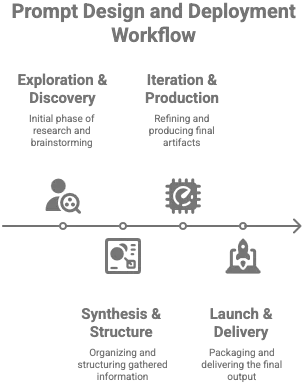
Every master craftsperson works from blueprints, but the best blueprints emerge from countless hours of actual building. My AI collaboration workflow follows a four-stage architecture that developed not from theory, but from repeatedly making mistakes and noticing what worked.
The structure divides into two main phases: Prompt Design (where we figure out what we’re building) and Prompt Deployment (where we actually build it). But these phases spiral rather than progress linearly—each stage reveals something that sends us back to earlier questions with deeper understanding.
Two Phases: Design as Foundation, Deployment as Discovery
Prompt Design Phase establishes the sandbox where our project takes place—objectives, scope, support resources, direction. Without this foundation work, I remain unconvinced that I’ve advanced my thinking enough to integrate new knowledge with existing learning, challenge my assumptions, or allow emerging thoughts to develop properly.
This phase feels like the planning stages of furniture building: we’re not just deciding what to make, but understanding why we want to make it, who will use it, how it fits with everything else we’ve created.
Prompt Deployment Phase executes the design while remaining open to discovery. This phase transforms human-AI collaborative thinking into polished, multi-format deliverables. But execution here doesn’t mean mindless following of plans—it means building with enough flexibility to honor what emerges during the process.
Four Construction Stages: The Pattern I Keep Returning To
These stages developed organically from practice:
- Exploration & Discovery: Gathering inspiration, selecting materials, understanding grain patterns
- Synthesis & Structure: Creating detailed plans, selecting joinery methods, preparing cut lists
- Iteration & Production: The actual building process—cutting, fitting, adjusting, refining
- Launch & Delivery: Applying finish, final quality check, creating sales and delivery materials
What surprises me is how often I find myself cycling back through earlier stages, each return revealing something I couldn’t see before. The stages provide structure, but the work itself teaches me when structure needs to bend.
The Dance of Collaborative Roles
At each stage, human and AI activities complement rather than compete, though maintaining this balance requires constant attention. Human-centered AI workflow design ensures that:
- Humans provide vision, direction, quality standards, and ethical oversight
- AI provides research capability, synthesis power, format flexibility, and execution efficiency
- Both contribute to iterative refinement, with humans maintaining final authority over direction and standards
But these roles blur in practice. Sometimes AI synthesis reveals something that shifts my vision. Sometimes human direction leads us into dead ends that AI pattern recognition helps us escape. The key lies not in rigid role definitions, but in maintaining awareness of who’s leading the dance at any given moment.
Quality Control: The Questions That Keep Us Honest
AI quality assurance happens throughout the process, not as afterthought. Each stage includes validation checkpoints where human judgment evaluates AI output against project objectives and quality standards. But I’ve learned that the most important quality control happens in the questions we ask ourselves.
Am I using AI to explore possibilities I’ve imagined, or am I letting it imagine for me? Does this output serve human-defined purposes, or have I begun optimizing for what AI does well? When I read what we’ve created together, can I still recognize my own thinking, enhanced but not replaced?
These questions don’t have simple answers, but asking them keeps the collaboration honest.
What Changes When We Work This Way
This workflow achieves two types of transformation that I didn’t anticipate: epistemological (discovering new ways of being) and preference (discovering new paths of becoming). The process doesn’t just create content—it changes how we think, what we notice, what becomes possible.
I find myself thinking differently even when not working with AI. The habit of articulating clear direction before seeking assistance has improved my human collaborations. The practice of building on existing knowledge rather than starting from scratch has made my solo work more grounded and substantial.
Stage 1: Inspiration and Material Selection (Exploration & Discovery)
The first stage feels like wandering through the forest, looking for the right tree. We’re gathering inspiration from sources that machines can access but cannot truly understand—the texture of lived experience, the weight of accumulated wisdom, the particular way light falls on our specific questions.
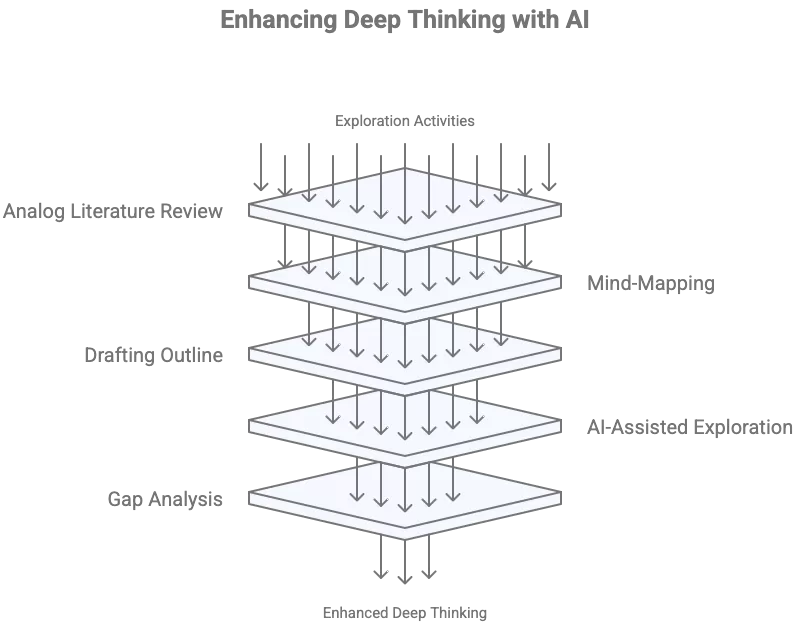
Generated in collaboration with Napkin.ai: This is where we learn the patience that makes partnership possible—like a craftsperson who knows that the quality of finished work depends entirely on the care taken in selecting and preparing materials. The funnel shows how different forms of exploration feed into something larger than any single activity could produce. We begin broadly with analog literature review, then move through mind-mapping and drafting, adding AI-assisted exploration only after we’ve established our own thinking. Notice how the arrows multiply as they flow downward—this isn’t about narrowing our focus, but about allowing diverse streams of discovery to converge into enhanced deep thinking. What emerges at the bottom isn’t just knowledge, but the kind of understanding that can only develop when we resist the urge to rush toward answers and instead dwell thoughtfully in questions.
Human Activities: What Only We Can Do
Analog Literature Review: Reading With Our Bodies
Before any AI involvement, I consume content the traditional way: reading books with my hands, watching videos with full attention, attending conferences where I can observe the spaces between words. This analog literature review serves the same function as studying traditional joinery techniques—it builds foundational knowledge that informs every subsequent decision.
I deliberately exclude AI assistance during this stage. Human minds need unmediated exposure to source material to develop authentic understanding and personal perspective. Combining human creativity with AI starts with ensuring humans have something meaningful to contribute to the combination.
The reading feels different when I know it’s feeding into AI collaboration. I find myself noting not just what resonates, but why it resonates, what questions it raises, how it connects to other ideas I’ve encountered. The knowledge that I’ll soon be translating these insights for an AI partner makes me more conscious of my own thinking patterns.
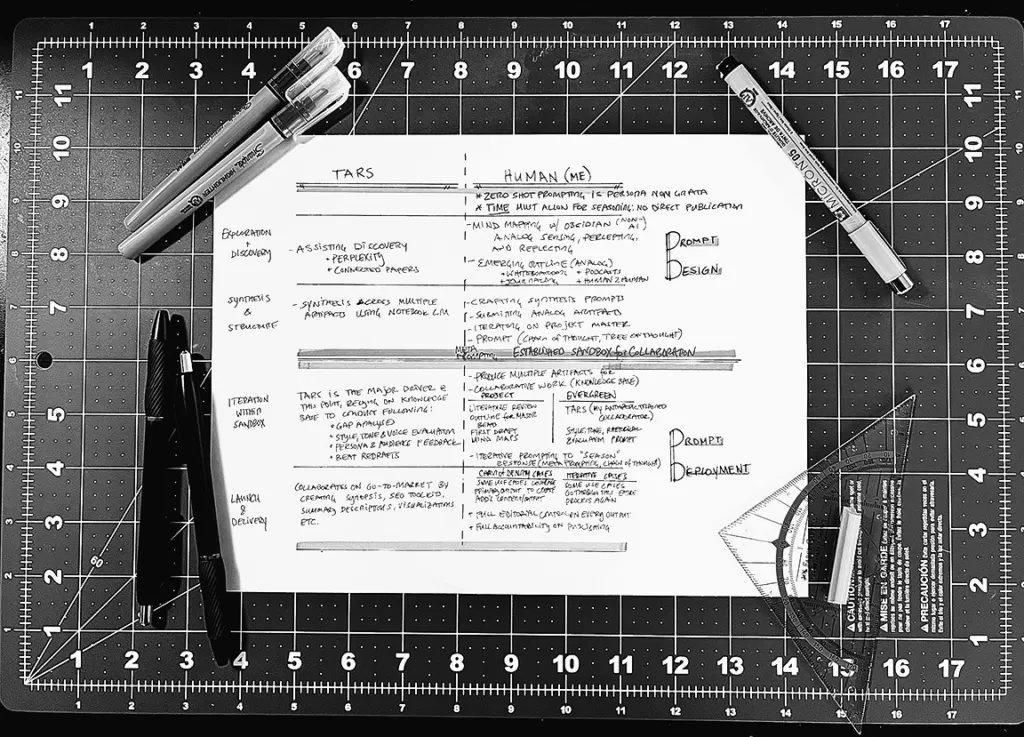
Before we think with machines, we must think as humans. This handwritten diagram captures the essential first step I’ve learned to never skip—the analog planning that happens with pen, paper, and the kind of thinking that only emerges when we slow down enough to let our minds wander and connect. Notice the drafting tools surrounding the workflow notes: compass, rulers, triangles. These aren’t accidents. The same precision tools that help craftspeople create lasting work serve the planning of human-AI partnership. What we see here is proof that the most advanced collaboration begins with the most ancient practice—putting pen to paper and thinking through problems with our hands.
Mind-Mapping with Obsidian: Following the Grain
Obsidian mind-mapping for AI projects serves as my primary tool for deep thinking—the place where connections emerge that I couldn’t plan or predict. Like studying wood grain patterns before cutting, mind-mapping reveals relationships, tensions, and possibilities within the subject matter.
I use Obsidian specifically because it’s non-AI supported, forcing genuine human synthesis work. These markdown files become artifacts in later stages, providing TARS with authentic human thinking to build upon rather than AI-generated starting points.
The process feels meditative. Ideas connect in ways that surprise me. Patterns emerge that I couldn’t see while consuming individual sources. Sometimes the most important insights appear not in my notes about specific topics, but in the spaces between topics—the unexpected bridges that span seemingly unrelated domains.
Initial Sketching: Giving Form to Intuition
Whiteboarding, journaling, and conversations with other humans create initial project sketches. This analog approach ensures that creative direction emerges from human insight rather than AI suggestion. Like rough furniture sketches, these artifacts capture vision and intent without premature commitment to specific execution details.
I’ve learned that some thoughts only emerge through hand movement—the particular way writing by hand engages different neural pathways than typing, the way drawing relationships reveals connections that words alone cannot capture. These sketches often look chaotic to anyone else, but they contain the DNA of what we’ll eventually build together.
AI Activities: Research as Extension, Not Foundation
Tools for Expanding Scope: Perplexity and Connected Papers
Once human direction is established, AI-powered research techniques enter the process. I use Perplexity AI research and Connected Papers for literature review to identify additional areas for inquiry. These tools function like consulting specialized reference books—they expand research scope without determining research direction.
The key principle here feels paradoxical: AI enhances discovery but doesn’t replace human curiosity and synthesis. These tools provide survey-focused exploration, not insight generation. They help identify what I might have missed, not what I should think about what I found.
What surprises me is how often AI research reveals blind spots in my initial thinking—not errors, exactly, but areas where my perspective had been limited by my particular background, reading habits, or conceptual frameworks. AI doesn’t correct my thinking so much as it expands the territory where my thinking can operate.
Gap Analysis: Seeing What We Cannot See
AI excels at pattern recognition across large information sets. Once I’ve established initial thinking through analog methods, AI can identify gaps in research, perspective, or approach. This resembles having an experienced craftsperson point out techniques we hadn’t considered for a particular project.
The output enhances human deep thinking in ways that remain survey-focused rather than insight-focused. AI suggests areas for further human investigation rather than providing the insights themselves. But even this suggestion process feels collaborative—AI patterns and human intuition working together to reveal the shape of what we don’t yet know.
Stage 2: Design and Planning (Synthesis & Structure)
With materials selected and initial inspiration gathered, this stage transforms exploration into actionable structure. Like finalizing dimensions, selecting specific joinery methods, and preparing detailed cut lists, we’re moving from possibility to commitment—but commitment that remains open to discovery.
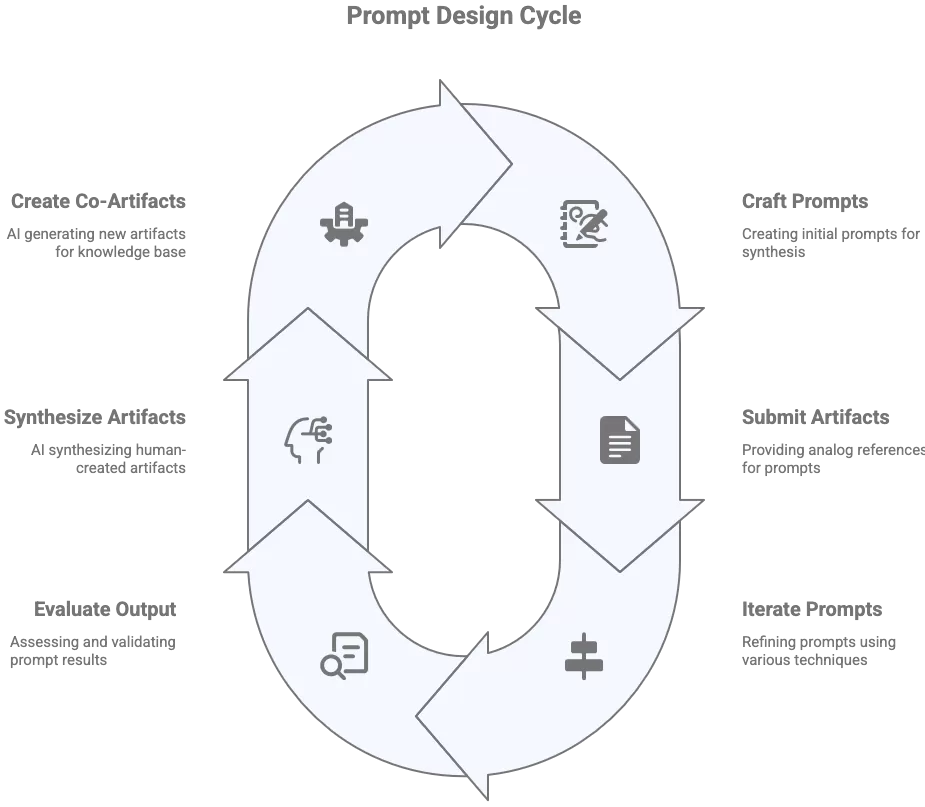
Generated in collaboration with Napkin.ai: This is where we learn the rhythm of collaborative thinking—like the back-and-forth between craftsperson and material that shapes fine work. The circular flow shows how prompt design becomes conversation: we craft initial prompts, submit our analog artifacts as reference points, then iterate and evaluate until something emerges that neither human nor AI could have achieved alone. What looks like a simple cycle is actually the heart of partnership—each revolution deepening our understanding of how to think together across different kinds of intelligence.
Human Activities: The Architecture of Intention
Prompt Crafting: Translating Vision into Language
Crafting prompts for AI writing requires synthesizing all research into actionable direction. This feels like finalizing furniture dimensions and joint selections—we’re committing to specific approaches based on all the exploration we’ve completed, but we’re also creating framework flexible enough to accommodate what we’ll discover during building.
I submit analog artifacts as references for AI prompt engineering, ensuring that AI synthesis builds on human thinking rather than replacing it. The prompts themselves become project artifacts, documenting not just what I want AI to do, but how human intelligence has shaped the collaborative approach.
The process taught me something about the precision of language I hadn’t expected. When preparing prompts for AI, I must articulate not just what I want, but why I want it, how it connects to larger purposes, what success looks like. This clarity serves the collaboration, but it also clarifies my own thinking in ways that benefit all my work.
Master Prompt Development: Building the Thinking Framework
Chain-of-thought prompting and tree-of-thought prompting techniques create detailed reasoning sequences. Like preparing comprehensive build instructions for complex furniture, these prompts map out the thinking process AI should follow to achieve human-defined objectives.
This stage involves multiple prompt techniques focused on ensuring AI follows human-established reasoning patterns. The goal isn’t constraining AI capability, but channeling it through frameworks that preserve what makes our thinking distinctly human.
I’ve learned that the best prompts feel like invitations to think together rather than instructions for task completion. They establish parameters while leaving room for the kind of discovery that makes collaboration valuable.
(see bottom of page for link to download the PDF version of this master prompt)
Quality Assurance: The Measure-Twice Principle
Meta-prompting for accuracy serves the carpenter’s principle of “measure twice, cut once.” Before moving to production, I use AI to examine its own initial outputs, validate reasoning chains, and identify potential issues in the planned approach.
This self-verification step catches problems before they compound in later stages, maintaining quality standards essential to responsible AI practices. But it also does something more subtle—it models the kind of reflective thinking that produces work worth building on.
AI Activities: Synthesis as Foundation Building
Creating the Knowledge Base with NotebookLM
NotebookLM for synthesis takes all human-created artifacts—literature review materials, mind maps, initial sketches, crafted prompts—and creates comprehensive knowledge base. This resembles organizing all materials, tools, and plans in our workshop before beginning construction.
NotebookLM creates co-artifacts that will be deployed in the next phase, ensuring that human thinking remains central to AI execution. These synthetic materials amplify human intelligence rather than substituting for it.
What emerges often surprises me. The AI synthesis reveals connections I hadn’t seen clearly, identifies themes I hadn’t articulated, organizes complex information in ways that make new insights possible. It’s not thinking for me, but it’s providing infrastructure that makes my thinking more powerful.
Supporting Documentation: Infrastructure for Collaboration
AI creates supporting documentation and deployment resources, like preparing jigs and templates that ensure consistent quality during production. These resources maintain human-defined standards while enabling efficient AI execution.
The key principle: Structure emerges from human intention, refined through AI capabilities. AI doesn’t determine what to build or how to build it—it helps optimize execution of human-designed approaches while remaining open to discovery.
Stage 3: Construction and Refinement (Iteration & Production)
This stage represents actual building—cutting, fitting, adjusting, refining. With plans established and materials organized, human creativity and AI precision work together to create the actual content, with continuous refinement based on both technical quality and creative vision.
But here’s what I didn’t expect: this stage feels less like following plans and more like improvisational theater. We have structure, we have roles, but what emerges depends on how we respond to what we discover while building.
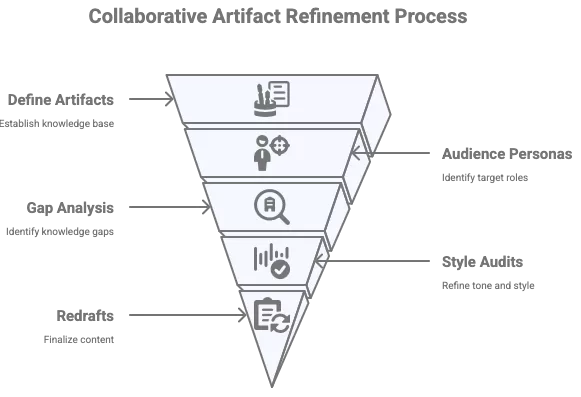
Generated in collaboration with Napkin.ai: This is where the real collaborative work happens—like the careful sanding and fitting that transforms rough-cut lumber into fine furniture. The funnel shape shows how we move from broad knowledge base definition down through increasingly focused refinements: understanding our audience, identifying gaps in our thinking, auditing for consistency, and finally crafting targeted improvements. What emerges isn’t just polished content, but the kind of iterative thinking that makes human-AI partnership genuinely collaborative rather than simply transactional.
Human Activities: Curating the Collaboration Space
Knowledge Base Definition: Organizing for Discovery
I define artifacts that constitute the knowledge base for collaborative effort, broken into Project Specific Artifacts (literature review materials, analog outlines, rough drafts, mind maps) and Evergreen Artifacts (style guides, tone preferences, rhetorical approaches that carry across projects).
This resembles organizing workshop specifically for the current build while maintaining tool and technique standards that apply to all work. AI knowledge base tools rely on human curation to ensure relevance and quality, but the curation process itself becomes a form of creative thinking.
I find myself learning about my own preferences and patterns during this organization. What themes do I return to repeatedly? What questions drive my curiosity? How do I naturally structure arguments? The knowledge base becomes both resource for AI and mirror for human self-understanding.
Audience and Persona Mapping: Building for Real People
Like understanding who will use finished furniture, I map target audiences and create personas for role-playing scenarios. This human activity ensures that AI refinement serves actual user needs rather than optimizing for abstract quality metrics.
AI persona mapping in later steps builds on this human-defined audience understanding, ensuring that AI feedback serves human-identified goals. But developing these personas requires the kind of empathy and social intelligence that remains uniquely human.
Style and Tone Guidelines: The Aesthetic Framework
I establish specific style, tone, and rhetorical approaches that guide AI refinement activities. Like determining finish quality and aesthetic details for furniture, these guidelines ensure that AI optimization serves human creative vision.
But style guidelines for AI collaboration feel different from style guidelines for human writing. I must articulate not just what I want the writing to sound like, but why those choices serve the deeper purposes of the work. The process makes me more conscious of my own voice and more intentional about when to modify it.
AI (TARS) Activities: Precision in Service of Vision
Gap Analysis: The Critical Eye
TARS identifies missing elements in content structure, argument development, or supporting evidence. Like spotting misaligned joints before final assembly, AI-driven gap analysis catches structural issues that could compromise the final piece.
This analysis builds on human-defined quality standards rather than imposing AI-determined quality criteria. The goal involves ensuring human vision achieves its intended effect, but the process often reveals gaps in my thinking that I couldn’t see myself.
I’ve learned to appreciate AI’s ability to identify patterns across large amounts of text that would be difficult for humans to track consistently. TARS notices when I’ve introduced a concept without defining it, when I’ve made claims without adequate support, when I’ve lost track of the thread that connects one section to another.
Style Audits: Consistency in Service of Coherence
Style and tone guidelines for AI enable consistency checking across all content elements. TARS audits for consistency in voice, argument structure, evidence quality, and audience appropriateness—like ensuring uniform finish quality across all surfaces of furniture.
These audits maintain human-established standards rather than optimizing for AI-preferred approaches. But the feedback often pushes me to be more intentional about choices I might have made intuitively.
Persona Feedback: Testing Against Reality
TARS role-plays target audience responses, providing feedback from different reader perspectives. This resembles testing furniture functionality from the end user’s perspective—ensuring that creative decisions serve practical user needs.
Persona feedback helps refine content for actual audience needs rather than creator preferences or AI optimization criteria. Sometimes this feedback reveals that what feels clear to me might be confusing to readers with different backgrounds or purposes.
Targeted Redrafts: Surgical Improvements
Based on gap analysis, style audits, and persona feedback, TARS provides targeted redrafts of specific content sections. Like adjusting individual furniture components that don’t meet standards, this refinement maintains overall project vision while improving specific elements.
The key principle: Iterative refinement where both human vision and AI precision contribute to achieving human-defined excellence standards. But the refinement process becomes collaborative dialog rather than simple correction.
Stage 4: Finishing (Launch & Delivery)
Like applying final finish, conducting quality checks, and creating sales materials, this stage packages primary content into multiple formats and delivery mechanisms while maintaining quality standards across all outputs.
But finishing work reveals something about the project that planning cannot anticipate. We discover not just what we’ve built, but what building it has taught us.
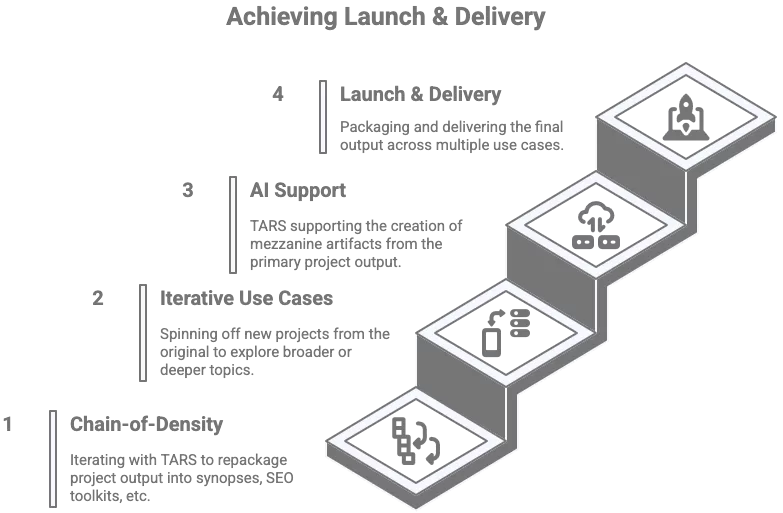
Generated in collaboration with Napkin.ai: This diagram maps how we move from individual project completion to multi-format delivery—like a craftsperson who builds not just a bureau, but also creates care instructions, arranges delivery, and plans the next piece in the collection. The stepped process shows how AI collaboration extends beyond single outputs into comprehensive content ecosystems.
Human Activities: Multiplication and Extension
Chain-of-Density Applications: Serving Different Needs
Chain-of-density use cases involve iterating with TARS to develop multiple repackaging of primary project output. Like creating catalog photos, care instructions, and delivery planning for furniture, these applications serve different audience needs and use contexts.
I guide creation of synopses, SEO toolkits, summary descriptions, visualizations, and other multi-format content delivery options. Human judgment determines which formats serve which purposes, ensuring that repackaging maintains original intent and quality standards.
What surprises me is how often creating these derivative formats reveals aspects of the main project I hadn’t seen clearly. Writing a synopsis forces clarity about core themes. Creating visualizations reveals structural patterns. Building SEO descriptions clarifies value propositions.
Iterative Extensions: Following the Trail
Sometimes the main project reveals opportunities for related work—like discovering that a bureau project could extend to matching nightstands or coordination with existing furniture. Iterative use cases spin up new projects that go broader or deeper on topics that emerged during original work.
These extensions typically return to the beginning of this workflow, ensuring that new projects receive the same depth of human thinking and AI collaboration that produced quality in original work. But they build on accumulated knowledge and refined collaboration patterns.
AI Activities: Optimization in Service of Access
Mezzanine Artifact Creation: Infrastructure for Impact
TARS focuses on creating supporting materials that enhance primary project output—like assembly instructions and warranty information for furniture. Mezzanine artifact creation includes SEO optimization, social media adaptations, email sequences, and other promotional materials.
These artifacts maintain quality and voice standards established in the main project while optimizing for specific delivery channels and audience contexts. The work requires both technical precision and creative sensitivity.
Multi-Format Adaptation: Meeting People Where They Are
Content repurposing with AI creates synopses, SEO toolkits, visualizations, and other materials. Like creating sales materials that highlight different furniture features for different customer types, these adaptations serve varied audience needs while maintaining core message integrity.
The key principle: The finished piece serves multiple purposes and audiences, with AI handling format optimization while humans maintain content integrity and strategic direction.
Quality Assurance Throughout: Standards That Evolve
Continuous quality control, tool maintenance, and skill development ensure that both the workflow and its outputs meet consistently high standards. Like any master craftsperson, maintaining quality requires attention to process, not just final products.
But I’ve learned that quality in AI collaboration means something more complex than traditional quality control. We’re not just checking for errors—we’re ensuring that the collaboration preserves what makes human thinking valuable while leveraging what makes AI capability powerful.
The Questions That Keep Us Honest
AI quality assurance happens at every stage, not as final review. Each stage includes checkpoints where human judgment evaluates AI contribution against project objectives, audience needs, and quality standards. But the most important quality control happens in the questions we ask ourselves:
Am I using AI to explore possibilities I’ve imagined, or am I letting it imagine for me? Does this output serve human-defined purposes, or have I begun optimizing for what AI does well? When I read what we’ve created together, can I still recognize my own thinking, enhanced but not replaced?
These questions don’t have simple answers, but asking them keeps the collaboration honest.
Ethical Checkpoints: Preserving What Matters
Ethical AI collaboration requires deliberate checkpoints that ensure human agency and intentionality throughout the process. These aren’t just about avoiding harmful content—they’re about maintaining the human-AI partnership dynamic that produces meaningful work.
Each stage includes explicit evaluation of whether AI is enhancing human capability or substituting for human thinking. When AI starts driving direction rather than amplifying human direction, the process requires recalibration.
But ethical considerations in AI collaboration extend beyond individual projects. What does this work contribute to broader human flourishing? How does our approach model responsible partnership with increasingly powerful tools? What are we learning that serves the larger community grappling with these questions?
Documentation: Transparency as Gift
Documentation best practices for AI ensure that thinking behind every decision remains visible and available for future reference. Like maintaining detailed project notes for complex furniture builds, documentation enables learning, improvement, and transparency.
This documentation serves multiple purposes: it enables process improvement, provides transparency for audience members concerned about AI use, and creates resources for future projects. But it also does something more personal—it helps me understand my own thinking patterns and collaborative preferences.
Evolution: The Work Teaches the Worker
Continuous workflow improvement means that the process itself evolves based on results, learning, and changing AI capabilities. Like any craftsperson who refines techniques based on experience, this workflow adapts while maintaining core principles.
Regular evaluation focuses on whether the process continues to achieve its goals: producing high-quality work that combines human creativity with AI capability while maintaining transparent AI workflows and responsible AI practices.
But the evolution happens not just through conscious analysis, but through accumulated experience. I find myself approaching new projects with intuitions developed through previous collaborations, sensing when to push forward and when to pause, recognizing patterns that signal effective collaboration or problematic drift.
Why This Matters: Beyond Individual Projects
Contributing to the craft community and advancing collective knowledge represents the broader purpose of transparent AI workflows. Like master craftspeople who share techniques to advance the entire field, transparent AI collaboration serves purposes beyond individual projects.
We’re all part of a much larger experiment in what it means to think alongside machines. None of us knows where this leads, but we can commit to traveling there thoughtfully.
Transparency as Community Standard
AI workflow transparency serves the broader community by modeling responsible AI practices and enabling others to develop their own approaches. Like sharing woodworking techniques that advance everyone’s capability, transparency in AI collaboration advances collective understanding of human-AI partnership possibilities.
This isn’t about convincing others to adopt my specific methods—it’s about contributing to community knowledge that enables everyone to develop better approaches. We’re all experimenting with how to maintain human agency while leveraging AI capability, and we learn more together than we can learn alone.
Modeling Partnership: What We’re Really Building
Ethical considerations in AI collaboration require modeling responsible partnership approaches that maintain human agency while leveraging AI capability. This demonstrates that advanced AI collaboration can enhance rather than replace human creativity and critical thinking.
But I think we’re building something more significant than individual projects or even individual workflows. We’re developing cultural patterns for relating to increasingly powerful artificial intelligence in ways that preserve what we value about human consciousness while remaining open to transformation.
Knowledge Sharing: The Long Game
AI workflow best practices develop through community sharing and iteration. By documenting and sharing approaches, we advance collective understanding of building effective AI workflows that serve human purposes rather than simply optimizing for AI capabilities.
This knowledge sharing enables others to build on proven approaches rather than starting from zero, accelerating community development of responsible AI practices. But it also creates space for disagreement, experimentation, and discovery of approaches none of us could develop alone.
Future-Proofing: Principles That Transcend Tools
AI collaboration for knowledge workers must prepare for AI capabilities that will likely exceed our current imagination while maintaining human-centered approaches. Transparent workflows create frameworks that can adapt to new tools while preserving core principles of human agency in AI projects.
The specific tools we use today will become obsolete. The principles we develop for maintaining human agency, ensuring ethical collaboration, and producing meaningful work will outlast any particular AI system. We’re not just learning to use current AI—we’re developing wisdom for relating to artificial intelligence as it continues evolving.
The Completed Bureau: What We’ve Built Together
When I step back to examine what this AI collaboration workflow has produced, I see something more complex than efficient content creation. The process has developed thinking capabilities, expanded creative range, maintained ethical standards, and contributed to community knowledge about human-AI partnership possibilities.
But more than that, the work has changed me. I think differently even when not working with AI. The discipline of articulating clear direction before seeking assistance has improved my human collaborations. The practice of building on existing knowledge rather than starting from scratch has made my solo work more grounded and substantial.
What This Process Achieves Beyond Content
This workflow accomplishes more than producing polished outputs. It develops the capacity for collaborative thinking across different types of intelligence. It creates frameworks for maintaining human agency while leveraging AI capabilities. It models approaches to complex problems that honor both technical possibility and humanistic values.
Each project builds expertise that serves future work rather than simply producing isolated outputs. The methodology becomes a form of capability development, ensuring that each collaboration teaches us something about effective partnership with artificial intelligence.
The Method as Living Practice
Human-centered AI workflow design continues evolving based on results, learning, and new AI capabilities. Like any craft skill, the methodology improves through practice, reflection, and adaptation to new tools and techniques.
This evolution maintains core principles while adapting methods to serve changing needs and capabilities. We’re not just using AI—we’re learning to think with it in ways that make both human and artificial intelligence more powerful.
An Invitation Rather Than Instructions
Rather than advocating for universal adoption of my specific methods, I’m inviting others to develop transparent AI workflows that serve their particular needs, values, and creative goals. The principles matter more than specific techniques.
Building effective AI workflows requires understanding our own creative processes, ethical standards, and quality criteria, then designing AI collaboration that enhances rather than replaces human capabilities. We each bring different backgrounds, purposes, and constraints to this work.
The Foundation for What Comes Next
This workflow foundation enables increasingly sophisticated projects that leverage accumulated knowledge, refined collaboration techniques, and developed AI partnership skills. Like building workshop expertise that enables more complex furniture projects, this approach creates capabilities that compound over time.
Each project builds toward greater human-AI collaboration sophistication while maintaining the ethical and quality standards that make the work meaningful. But it also builds toward something larger—a community of practitioners developing wisdom for navigating an increasingly AI-integrated world.
Resources for Our Shared Journey
As we continue developing these approaches together, certain tools and techniques have proven particularly valuable for building AI collaboration workflows that honor both human creativity and AI capability.
Essential Tools for Transparent AI Partnership
- Research Phase: Perplexity AI for expanding scope, Connected Papers for mapping knowledge domains
- Deep Thinking: Obsidian for non-AI supported human synthesis and connection-making
- Knowledge Base: NotebookLM for synthesis and co-artifact creation
- Collaboration: Claude (TARS) for advanced prompt engineering and iterative refinement
Techniques Worth Exploring
Chain-of-thought prompting, tree-of-thought prompting, and meta-prompting for accuracy represent advanced approaches that require practice and adaptation to individual creative processes. Workflow diagrams for AI projects provide visual frameworks for implementing these approaches.
But techniques matter less than principles. Focus on developing AI collaboration for knowledge workers that enhances existing strengths while expanding creative capabilities. The goal remains human-AI synergy that produces better work than either human or AI could create alone.
The Real Question We’re All Working On
This ultimate guide to transparent, ethical AI collaboration provides foundation for developing responsible AI practices, but it can’t answer the fundamental question each of us must explore: How do we remain fully human while thinking alongside machines?
We’re all experimenting with this question. Some of us approach it through writing, others through research, analysis, creative work, or practical problem-solving. We bring different skills, different concerns, different hopes for what human-AI collaboration might become.
But we share the same essential challenge: learning to work with artificial intelligence in ways that honor what we value about human consciousness while remaining open to transformation we cannot yet imagine.
The future of creative work lies not in choosing between human and artificial intelligence, but in developing partnership approaches that honor the unique strengths of both. We’re building more than individual projects or even individual workflows—we’re developing cultural wisdom for one of the most significant transitions in human history.
What will we discover together as we continue learning to think alongside artificial minds? What bureau will we build with our AI collaboration partners that we could never have imagined building alone?