


Listen to the companion Sparks + Embers episode for this Kindling feature article below.
This article is a part of our Goodpain Guide to Human Learning Series which is a part of our content that focuses on Contemplation & Reflection, one of our Goodpain Pillars.
Our Next Article will be available the week of 7 July 2025 and titled, What AI Learning Reveals About Human Uniqueness.
What a forty-year-old piece of poplar taught me about human consciousness, artificial intelligence, and the art of contemplative learning
The Question I Didn’t Know I Was Asking
The poplar had been waiting for me for forty years.
It started as a seed in some forest, pushed up through decades of seasons, converted sunlight into cellulose, weathered storms and droughts, until a sawyer’s blade transformed it into the rough plank now resting on my workbench. The wood grain told the story – tight rings from lean years, wider bands from seasons of abundance, a small knot where a branch once reached toward light.
I picked up the hand plane, its weight surprising in my hands. The instructor had demonstrated the basics: check that the blade is “proud enough to cut but not so proud that we’ll muscle through the job.” Adjust the cutting depth with small, precise turns. Read the grain. Work with it, not against it. Body position matters – let the core do the work, not just the arms.
Simple enough. The goal seemed straightforward: create a piece of wood square on all four sides. Everything else in woodworking depends on having stock that’s true. Square is the foundation, the standard against which everything else is measured.
I thought I understood. I had watched the demonstration, absorbed the instructions, processed the same visual information as everyone else. I knew about grain direction and blade angles.
But as I would soon discover, knowing about something and knowing it through contemplative engagement are two different creatures. I was about to confront a question that reaches far beyond craft: How do we know when we can trust what we think we know?
The moment I took my first stroke, the wood wasn’t waiting to be shaped. It was demanding I learn how to evaluate conflicting sources of truth.
Authentic Human Learning Principle One: Multi-Source Evaluation – When Reality Speaks Three Languages
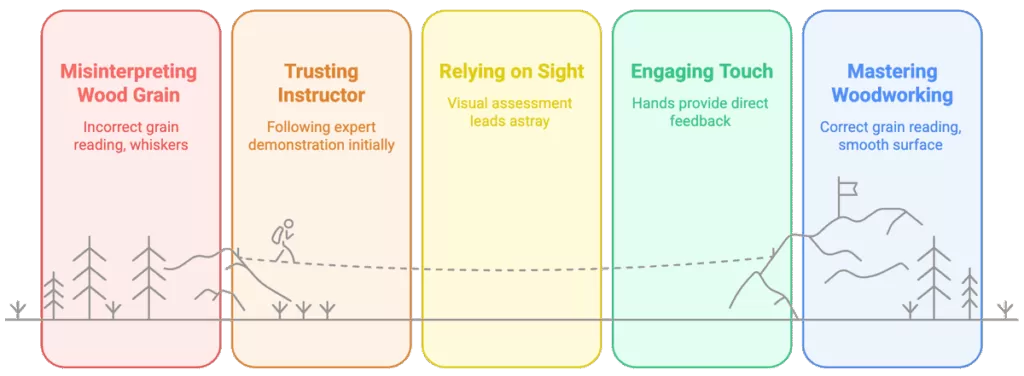
The plane skipped and caught. Small hairs of torn grain appeared on the surface – the poplar’s way of saying “not like that.” I had oriented the plank as demonstrated, reading the grain pattern to determine which direction the fibers sloped. But my interpretation was wrong. Each stroke against the grain produced those telltale whiskers, a gentle but persistent contradiction.
I faced a fundamental dilemma: Who should I trust?
The instructor had shown me one thing. My eyes seemed to confirm his teaching. But my hands were learning something different – the texture under my fingers, the resistance in my shoulders, the sound of the blade biting into fiber all suggested my interpretation was flawed. Three sources of information, three different messages.
This is the challenge of being human: we’re engaged in constant contemplative evaluation of which sources of knowledge deserve our trust. Unlike other animals, we’ve evolved a capacity that makes this evaluation both more powerful and more dangerous than anything else in the natural world.
The Hierarchy That Failed
I trusted the instructor’s demonstration first. That seemed reasonable – he was the expert, the authority figure. But when I tried to replicate his technique, the wood disagreed with my interpretation. So much for expertise.
Then I trusted my eyes, studying the grain pattern with what I thought was attention training practice. Visual assessment seemed more direct than relying on someone else’s interpretation. But my visual reading kept leading me astray. The wood’s behavior contradicted what I thought I was seeing. So much for perception.
I started trusting my hands. The texture, the resistance, the subtle vibrations traveling up through the plane handle – these seemed like the most direct sources of information. When I followed what my hands were telling me rather than what my eyes thought they saw, the technique began to work.
Around me, my classmates were trapped in this same evaluation challenge, but they’d made an error: they trusted their initial framework so much that they couldn’t hear what reality was trying to tell them. They’d created what I started thinking of as “closed loops” – systems of belief that interpreted everything as confirmation of what they thought they knew.
When their technique didn’t work, they didn’t question their understanding. They questioned the wood, the tool, the instructions, even their own competence – everything except the possibility that their framework for making sense of the situation might be incomplete.
I could have been one of them. How often in other areas of my life do I double down on approaches that aren’t working instead of pausing to listen? How often do I mistake my initial expectations for reality itself, then blame the world when it doesn’t cooperate with my script?
"What sources am I trusting without examining their reliability?"
Question No. 1
Authentic Human Learning Principle Two: Relational Learning – How We Connect the Unconnected
Most animal learning follows a straightforward pattern: do something, get a result, adjust behavior. Press the lever, get food. Touch the hot stove, feel pain, avoid the stove. It’s direct, mechanical, efficient – and it eliminates the trust evaluation problem by keeping learning simple and immediate.
But humans evolved something unprecedented. We developed the capacity to create relationships between things that were never connected. We learned not just to respond to what happens, but to derive meaning from what might be related. This changed everything about how we learn – and how we suffer.
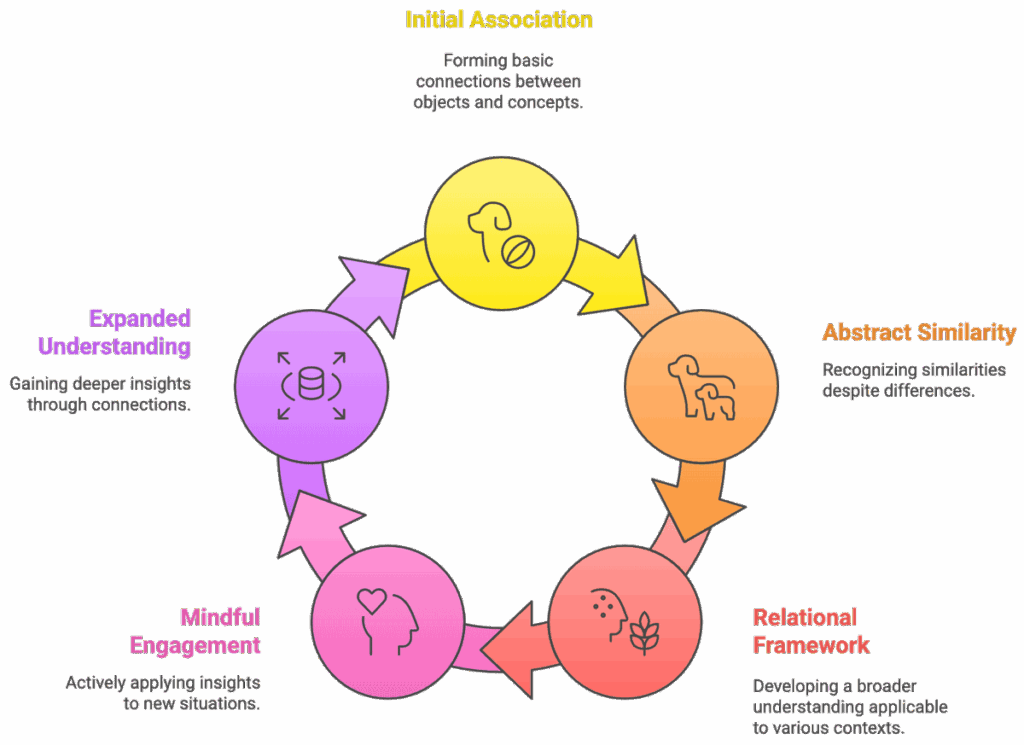
Consider how a child learns the word “dog.” She sees a golden retriever, hears the word “dog,” and forms that basic association – standard animal learning. But then something remarkable occurs. When she later encounters a chihuahua, she recognizes it as the same category despite sharing almost no physical features with that first golden retriever. She’s derived a relationship based on abstract similarity rather than direct experience.
Back in the workshop, this is what happened when I learned to read grain direction in one piece of poplar. I wasn’t just learning about that specific board. I was developing a relational framework – a way of sensing resistance versus cooperation – that I could apply to maple, oak, cherry, even to reading the “grain” in human personalities or organizational cultures. One insight about working with versus against material became a universal template I could recognize everywhere.
This is how human understanding grows through mindful engagement rather than mere repetition. Each new insight doesn’t just add to our knowledge – it multiplies by connecting to everything we know. Learning to listen to one piece of wood taught me about all materials. Understanding how to read feedback in the workshop prepared me to read feedback in relationships, creative projects, my own internal landscape.
"What patterns am I learning that could apply beyond their original context?"
Question No. 2
Authentic Human Learning Principle Three: Derived Meaning-Making – The Gift That Poisons Itself
Here’s where our contemplative learning capacity becomes dangerous.
The same mind that can connect woodworking principles to relationship wisdom can also connect “I made a mistake” to “I’m incompetent” to “I’ll never succeed” to “I’m worthless.” The human capacity for creating meaning through relationship works just as well for building webs of anxiety and self-doubt as it does for building webs of understanding and skill.
This is why those frustrated classmates couldn’t hear what their wood was teaching them. They’d derived the meaning: “If I follow the instructions, the material should comply.” When reality contradicted this framework, instead of updating their understanding, they doubled down on force. Their network of beliefs about control, competence, and how learning “should” work prevented them from entering into dialogue with their materials.
I see this pattern in myself. When a project doesn’t go as planned, I don’t just experience disappointment about that specific situation. My mind connects it to every other failure, every other time I’ve fallen short of my expectations, every fear I carry about my fundamental adequacy. What started as simple feedback about a particular performance becomes evidence for a story about my entire identity.

We don’t just learn that hot stoves hurt. We learn that hurt means danger, danger means vulnerability, vulnerability means we can’t trust the world, and therefore we must control everything to feel safe. One burned finger becomes a philosophy of life.
The animal kingdom doesn’t experience depression, anxiety, or existential dread – not because other animals don’t face threats, but because they can’t create these cascading networks of derived meaning. They’re limited to direct experience. We have the gift and curse of living in webs of relationship that exist in our own minds.
This understanding shows why the contemplative evaluation skills I was developing in the workshop matter: our survival as conscious beings depends on learning to distinguish between helpful and harmful webs of meaning.
The Third Question: What meaning am I making, and is it helpful or harmful?
"What meaning am I making and is it helpful or harmful?"
Question No. 3
Authentic Human Learning Principle Four: Material Fluency – Learning to Read What Is
Something shifted during those hours with the poplar. I began to recognize that the wood wasn’t just passive matter waiting to be shaped – it was an active participant in a conversation I was learning to understand. I was developing a replicable process for evaluating different sources of information through what I now call “material fluency.”
This wasn’t magical thinking. The wood doesn’t have consciousness. But it does have properties – density variations, grain direction, moisture content, internal tensions – that respond to my actions in predictable ways. Learning to read these responses became my first lesson in the ability to distinguish between force and collaboration, between projection and perception, between what I want to be true and what is.
As the afternoon progressed, I found myself developing systematic evaluation skills through attention training practice. I could feel when the grain was about to change direction before I could see it. I learned to hear, in the subtle shift of sound, when the blade needed adjustment. My hands began to read the wood’s story: this section grew in shade, that knot marked a year of stress, this smooth patch came from a period of steady growth.
I was becoming bilingual in a language I hadn’t known existed. I was learning how to learn languages – how to develop trust in sources of information that proved themselves reliable through consistent feedback.

The Recognition
The real moment came when I started recognizing this same evaluation process everywhere else in my life.
In my marriage, I’d been learning – often through trial and error – to read the subtle signals that indicate when my wife needs space versus when she needs connection. Her tone, her posture, the particular way she holds her shoulders all speak a language of emotional state and relational need. The more fluent I become in evaluating these different sources of information, the more we can collaborate rather than react to each other.
With my children, I’ve learned to read what I call “situational grain” – how the same child needs different approaches depending on context, energy level, and developmental stage. My eldest might respond well to direct conversation when she’s well-rested and feeling secure, but that same directness can splinter into defensiveness when she’s overwhelmed. Learning to evaluate these contextual patterns requires the same attention to multiple information sources that I developed with wood.
Even ideas themselves have their own grain, their own natural directions that determine how they can be approached. Some concepts need to be evaluated through analysis, broken down into component parts. Others show themselves only through story, metaphor, embodied experience. Try to force an intuitive insight through logical analysis and it fragments. Try to systematize a paradox and the truth is lost.
This evaluation process isn’t mystical – it’s relational intelligence developed through attention and practice. Like learning to read wood grain, it requires slowing down enough to notice feedback, being humble enough to adjust when reality contradicts our assumptions, and being patient enough to let understanding emerge rather than forcing it.
"Where am I forcing when I should be listening?"
Question No. 4
Authentic Human Learning Principle Five: Consciousness That Evaluates – The Human Advantage
Standing in that workshop, surrounded by the sweet smell of poplar shavings, I began to understand why humans can develop this kind of evaluative fluency while other animals remain limited to simpler forms of learning.
We possess something that seems unique in the animal kingdom: the ability to watch ourselves think. When I noticed myself getting frustrated with the wood, then chose to get curious instead, I was exercising a human capacity for stepping back and observing my own mental processes. This metacognitive awareness is what makes contemplative trust evaluation possible.
This self-awareness allows us to catch ourselves in the act of creating meaning and adjust how we’re interpreting feedback. I could observe my internal state affecting my technique. I could notice when my expectations were distorting my perception. I could watch myself creating stories about what was happening and choose different stories.
A chipmunk gathering nuts doesn’t worry about whether it’s “good enough” at the task. It doesn’t create narratives about its fundamental adequacy based on a single failed attempt. It responds to environmental feedback and adjusts. We, however, can create what I think of as “stories about our stories” – beliefs about our beliefs, meanings about our meanings.

This is both our greatest strength and our greatest vulnerability. The same consciousness that allows us to evaluate and derive insights from simple experiences also allows us to torture ourselves with meanings that exist nowhere but in our own minds.
But this capacity for self-reflection also makes possible something that no other animal seems capable of: dialogue with reality. When I learned to listen to the wood, I wasn’t just responding to stimuli. I was entering into a relationship where my awareness could be educated by direct contact with something beyond my own thoughts.
"How can I use my capacity for self-awareness to imrpove my learning?"
Question No. 5
The Hidden Curriculum: How Learning Really Happens
What I didn’t expect when I first picked up that hand plane was how much more I would learn beyond the stated objective of creating square stock. The official curriculum was about woodworking technique – grain direction, blade adjustment, body mechanics. But the hidden curriculum was far more: I was learning how to learn through contemplative engagement.
Each stroke that went against the grain, each adjustment that didn’t quite work, each moment of frustration followed by the choice to slow down and listen – these were lessons in evaluation that no meditation app could teach. I was developing what can only be called relational intelligence: the capacity to sense when I’m fighting reality versus when I’m collaborating with it.
The Quakers have a word for this process: “seasoning” – allowing time for experiences to soak in, to connect with other experiences, to show patterns that weren’t visible in the moment. My classmates who struggled weren’t lacking information. They had received the same demonstration, the same instructions, the same access to techniques. What they seemed to resist was the time required for seasoning, the willingness to let their expectations be educated by reality rather than the other way around.
This is how the most learning happens – through relationship and practice rather than information transfer. The master craftspeople I’ve known don’t just teach technique; they’re teaching how to develop the listening stance that makes all other learning possible. They understand that the real apprenticeship isn’t in acquiring skills but in cultivating character – the character to trust the evaluation process even when it contradicts our initial assumptions.
The Artificial Mirror
As I watch artificial intelligence systems generate sophisticated responses to human queries, I find myself returning to that afternoon in the workshop. The questions that seemed curious then now feel urgent.
Current AI systems excel at processing vast amounts of information and recognizing patterns. They can describe wood grain texture, explain proper planing technique, even generate advice about woodworking that sounds knowledgeable. But when an AI describes the resistance of working against the grain, is it drawing on something like the multi-source evaluation process I learned in the workshop, or is it manipulating symbols according to learned patterns?
Do these systems exhibit anything like the self-awareness that allowed me to notice and adjust my own learning process? When they adjust their responses based on feedback, are they engaging in evaluation, or are they executing sophisticated but unconscious algorithms?
The workshop taught me that learning is mutual. I shaped the wood, and the wood shaped me. The conversation changed both participants. As we develop relationships with artificial minds, the question becomes: Are these systems capable of the kind of trust evaluation that transforms the evaluator, or are they forever limited to processing inputs and generating outputs without change to their underlying nature?
This isn’t just a technical question. The evaluation skills I developed in that workshop – learning to distinguish between different sources of information, recognizing when my expectations are distorting my perception, developing patience for the seasoning process – these same skills become necessary for a world where artificial minds can produce convincing but potentially unreliable output.
Five Questions for Any Learning Source
The conversation I discovered with that piece of poplar wasn’t unique to woodworking. It was a template for all learning. Everything around me – my relationships, my work, even my own thoughts and emotions – has its own grain pattern that I can learn to read. Everything responds to force versus collaboration. Everything has something to teach if I develop the evaluation skills to hear it.
Here’s the practical framework that emerged from those hours in the workshop:
- What sources am I trusting, and why? (Multi-Source Evaluation)
- What patterns am I learning that could apply beyond this context? (Relational Learning)
- What meaning am I making, and is it helpful or harmful? (Derived Meaning-Making)
- Where am I forcing when I should be listening? (Material Fluency)
- How can I use my self-awareness to improve this process? (Consciousness That Evaluates)
These five questions work whether we’re learning woodworking, relationships, evaluating AI output, or wrestling with our own internal landscape. They represent what I believe makes human learning irreplaceable: our capacity for contemplative evaluation that transforms not just our knowledge, but our consciousness itself.

How Machines Miss Authentic Human Learning
Standing in that workshop surrounded by shavings and the lingering scent of wood, I realized I had discovered something that extends far beyond craft. But this recognition also raises urgent questions about the artificial minds we’re creating.
The evaluation stance I learned in that workshop – the capacity to distinguish between reliable and unreliable sources of information, between dialogue and sophisticated mimicry – may be what we need to work with this new relationship responsibly.
Because the fundamental question isn’t whether AI can mimic human responses, but whether it can engage in the kind of mutual evaluation process that transforms both participants. The wood taught me that learning changes the learner.
In the next article, we’ll examine what happens when we create machines that seem to learn but may be missing the evaluation process that makes learning trustworthy – and discover what we can understand about consciousness itself by watching how artificial intelligence learns differently.
The stakes have never been higher. If we’re going to live wisely in a world where artificial minds can produce convincing output, we need to understand not just how they learn, but how we can tell the difference between authentic understanding and brilliant simulation.
Research References
Andrews, K., 2010, “Animal Cognition,” The Stanford Encyclopedia of Philosophy (Fall 2010 Edition), Edward N. Zalta (ed.). URL: https://plato.stanford.edu/archives/fall2010/entries/animal-cognition/
British National Corpus/demographic. URL: http://info.ox.ac.uk/bnc/
Cowie, F., 2016, “Innateness and Language,” The Stanford Encyclopedia of Philosophy (Winter 2016 Edition), Edward N. Zalta (ed.). URL: https://plato.stanford.edu/archives/win2016/entries/innateness-language/
Downes, S., 2010, “Evolutionary Psychology,” The Stanford Encyclopedia of Philosophy (Fall 2010 Edition), Edward N. Zalta (ed.). URL: https://plato.stanford.edu/archives/fall2010/entries/evolutionary-psychology/
Garson, James, 2010, “Connectionism,” The Stanford Encyclopedia of Philosophy (Winter 2010 Edition), Edward N. Zalta (ed.). URL: https://plato.stanford.edu/archives/win2010/entries/connectionism/
Goldman, Alvin I., 2011, “Reliabilism,” The Stanford Encyclopedia of Philosophy (Spring 2011 Edition), Edward N. Zalta (ed.). URL: https://plato.stanford.edu/archives/spr2011/entries/reliabilism/
Hájek, A., 2003, “Interpretations of the Probability Calculus,” in The Stanford Encyclopedia of Philosophy, (Summer 2003 Edition), Edward N. Zalta (ed.). URL: https://plato.stanford.edu/archives/sum2003/entries/probability-interpret/
Hitchcock, Christopher, 2022, “Causal models,” in The Stanford Encyclopedia of Philosophy, Edward N. Zalta (ed.). URL: https://plato.stanford.edu/archives/spr2022/entries/causal-models/
Joyce, J., 2008, “Bayes’ Theorem,” The Stanford Encyclopedia of Philosophy (Fall 2008 Edition), Edward N. Zalta (ed.). URL: https://plato.stanford.edu/archives/fall2008/entries/bayes-theorem/
Markie, Peter, 2015, “Rationalism vs. Empiricism,” The Stanford Encyclopedia of Philosophy (Summer 2015 Edition), Edward N. Zalta (ed.). URL: https://plato.stanford.edu/archives/sum2015/entries/rationalism-empiricism/
Rendsvig, Rasmus and Symons, John, 2022, “Epistemic logic,” in The Stanford Encyclopedia of Philosophy (Spring 2022 Edition), Edward M. Zalta (ed.). URL: https://plato.stanford.edu/archives/spr2022/entries/logic-epistemic/
Robbins, Philip, 2015, “Modularity of Mind,” The Stanford Encyclopedia of Philosophy (Summer 2015 Edition), Edward N. Zalta (ed.). URL: https://plato.stanford.edu/archives/sum2015/entries/modularity-mind/
Samet, Jerry, 2008, “The Historical Controversies Surrounding Innateness,” The Stanford Encyclopedia of Philosophy (Fall 2008 Edition), Edward N. Zalta (ed.). URL: https://plato.stanford.edu/archives/fall2008/entries/innateness-history/
Schulte, O., 2006, “Formal Learning Theory,” The Stanford Encyclopedia of Philosophy (Spring 2006 Edition), Edward N. Zalta (ed.). URL: https://plato.stanford.edu/archives/spr2006/entries/learning-formal/
Straßer, Christian, and Antonelli, G. Aldo, 2019, “Non-Monotonic Logic,” The Stanford Encyclopedia of Philosophy (Winter 2012 Edition), Edward N. Zalta (ed.). URL: https://plato.stanford.edu/archives/win2012/entries/logic-nonmonotonic/
Talbot, W., 2001, “Bayesian Epistemology,” Stanford Encyclopedia of Philosophy (Fall 2001 Edition), Edward N. Zalta (ed.). URL: https://plato.stanford.edu/archives/fall2001/entries/epistemology-bayesian/
Disclosure Statement
This post was produced according to the approach outline in The Art of Transparent AI Collaboration Workflow (click to review).