Transform Community Building: How to Build Resilient Community Bonds
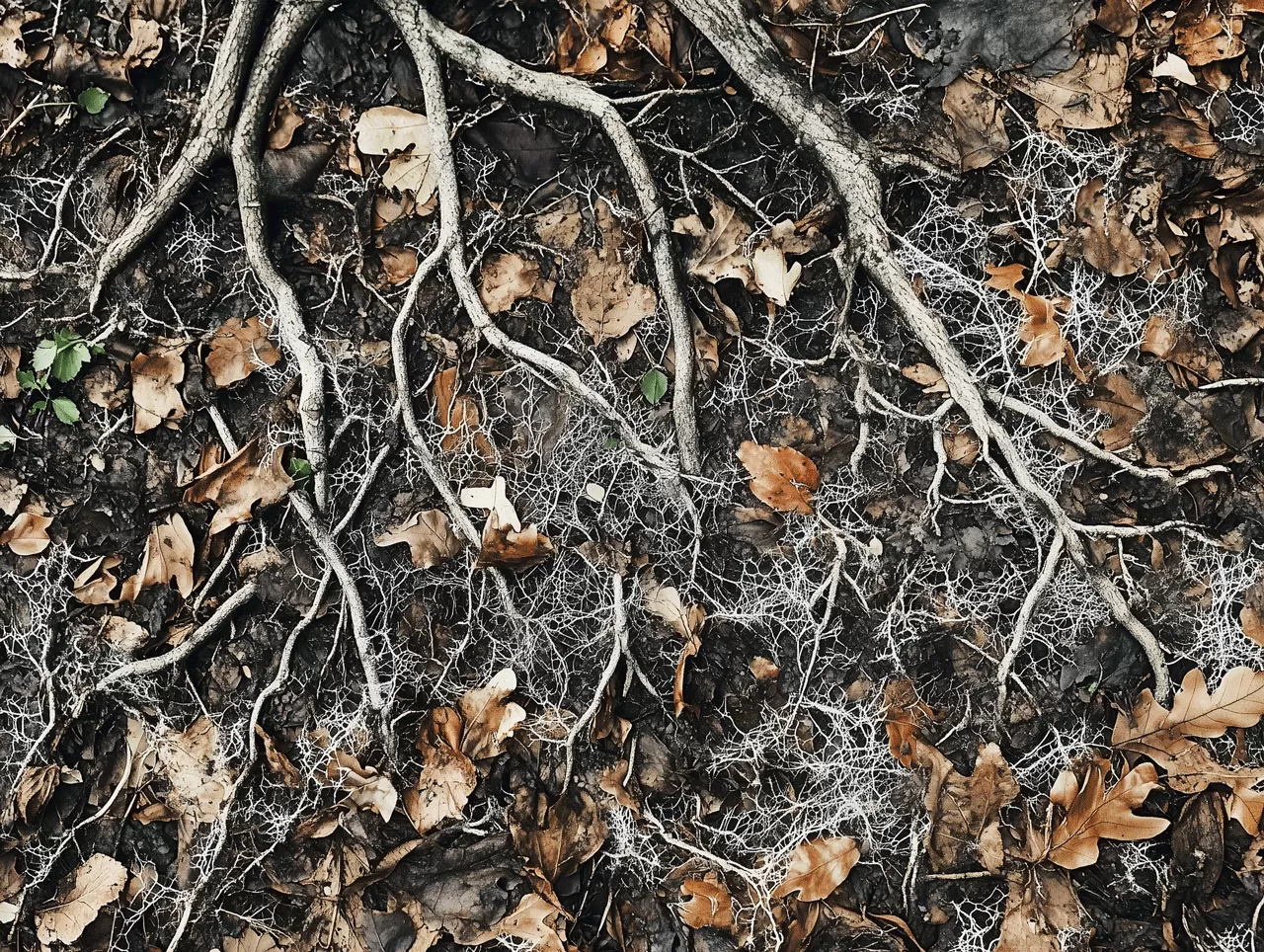
There’s something happening beneath our feet that changes everything we think we know about connection. Right now, as we read these words, thread-thin fungal filaments are pulsing with chemical conversations we can’t hear. The mycelial networks spreading through forest floors across the planet are sharing nutrients with trees that can’t photosynthesize, sending warning signals about incoming pests, redistributing resources from the abundant to the struggling—all without a central nervous system, without a plan, without keeping score. This underground internet has been perfecting community for 400 million years. We’ve been fumbling with it for about 10,000. Maybe it’s time we paid attention to what the mycelium knows about connection that we’ve forgotten.The Problem with Surface-Level Community
Most of what we call community building happens above ground—visible, measurable, immediate. We network at events, exchange contact information, create group chats, schedule regular meetups. We optimize for efficiency: maximum connections, clear objectives, quantifiable outcomes. The mycelium operates differently. It creates enduring abundance in community building through relationships that span decades, sometimes centuries, without any visible above-ground activity. While we’re busy networking on the surface, the real work of community formation happens in what philosopher Byung-Chul Han calls the space of “symbolic acts”—underground exchanges that create recognition and alliance without requiring constant communication. Community emerges not as a comfortable gathering of like-minded people, but as the fierce willingness to share life’s intensities without trying to escape or solve them. Think about what this means: the oak doesn’t have to become a pine to connect with it through mycelial networks. The ancient tree doesn’t have to justify its resource needs to the saplings it nourishes. The forest network doesn’t operate through affinity but through what we might call “committed interdependence”—the understanding that we’re already connected whether we feel like it or not.Why We Fear Underground Connection
Here’s what’s insidious about our surface-focused approach to community: it allows us to stay in control. When relationships happen primarily through planned activities and managed interactions, we can regulate how much of ourselves we reveal, how deeply we engage, how much we invest. The mycelial model asks for something different: the willingness to be genuinely present when life gets intense, without agenda, without timeline, without guarantee of return. This terrifies our productivity-obsessed culture. We want community building we can measure, relationships we can optimize, connections that deliver clear value. But as Han observes in The Disappearance of Rituals, our “compulsion of production” and “compulsion of authenticity” actively undermine the very conditions that allow authentic community to form. The mycelium doesn’t optimize. It simply flows—nutrients, warnings, support—trusting that the network itself ensures circulation over time.Sharing Life’s Intensities in Modern Communities: The Chemical Conversations
When a tree is attacked by bark beetles, it doesn’t suffer in silence. Through mycelial networks, it sends chemical signals throughout the forest: Danger here. Prepare defenses. Send help if possible. The network responds not with advice or solutions but with what the tree actually needs—defensive compounds, alternative resources, collective presence that changes the entire ecosystem’s response to threat. This is what sharing life’s intensities looks like when we move beyond surface communication toward what Han calls “community without communication”—connection that happens through symbolic recognition rather than information exchange.The Four Types of Mycelial Exchange
Warning Signals (Sharing Danger) When community members face crisis, the network responds not with problem-solving but with what we might call “collective presence”—the understanding that individual threats affect the entire system. This isn’t group therapy; it’s ecological response to disruption. Nutrient Flow (Sharing Resources) The mycelium redistributes abundance without keeping ledgers. Trees in sunny clearings share excess sugars with those in deep shade. Established giants support struggling saplings without requiring eventual repayment. The network operates on what economists call “gift economy principles”—giving creates relationship, and relationship creates abundance. Seasonal Circulation (Sharing Time) The forest network honors different rhythms of activity and rest. Spring brings intensive nutrient exchange supporting new growth. Summer flows focus on maintaining established connections. Autumn shifts toward storage and preparation. Winter slows to what appears to be dormancy but is actually deep network maintenance. Chemical Recognition (Sharing Identity) Perhaps most profound: the mycelium enables trees to recognize kin and respond differently to family versus strangers, to healthy neighbors versus diseased ones. This isn’t discrimination but sophisticated understanding of how different types of connection serve the larger ecosystem.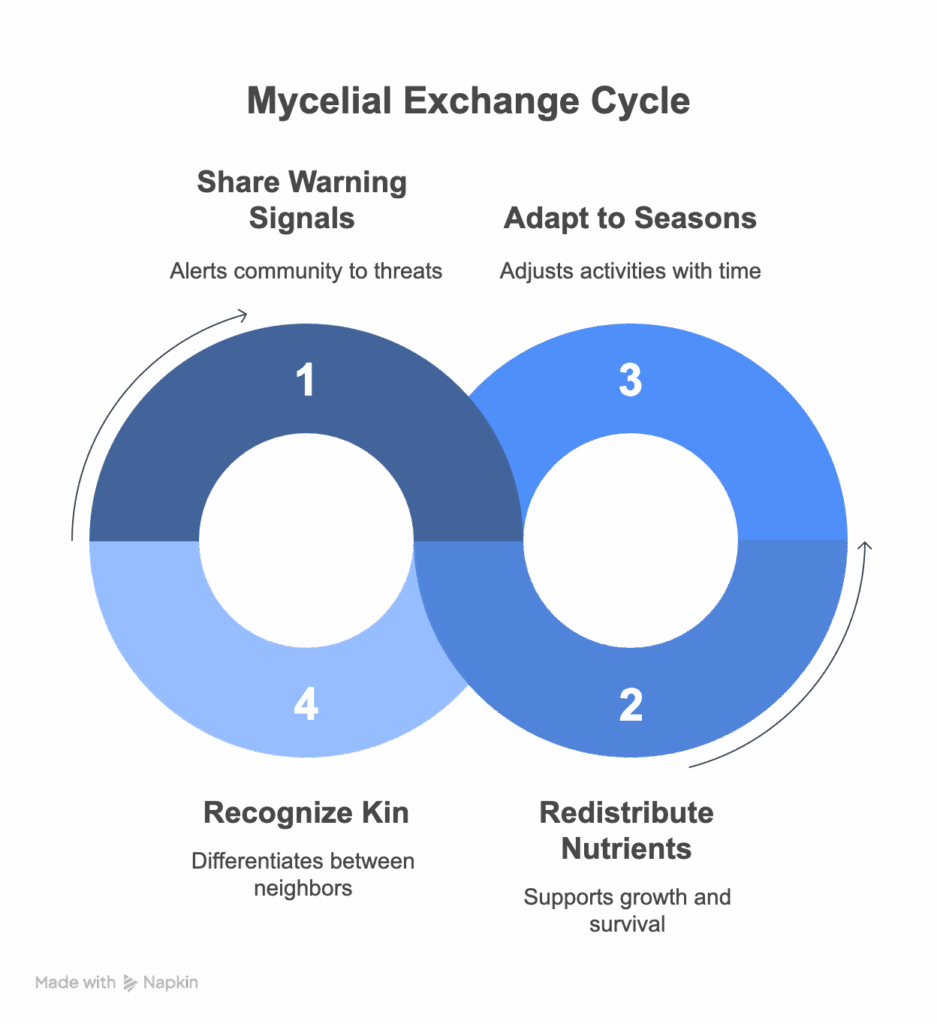
Generated with Napkin.ai
Non-Transactional Community Relationships: The Gift Economy Underground
The mycelial network never sends invoices. It doesn’t track who owes what to whom. It doesn’t suspend service when individual trees fall behind on their contributions. Yet somehow, over centuries, the flow balances—not through accounting but through what Robin Wall Kimmerer calls “the grammar of reciprocity.” Non-transactional community relationships mean we learn to operate like the mycelium: trusting that what flows through the network serves the whole, even when we can’t see immediate returns. This directly counters what Han identifies as neoliberalism’s transformation of community into “commodified and consumerized” relationships where even values like justice become “marks of distinction” that serve individual identity rather than collective connection.The Three Principles of Mycelial Community
Flow Without Ledgers Like fungi that share nutrients without tracking exchanges, we learn to offer our gifts freely—time, attention, resources, presence—trusting that the network ensures circulation. This doesn’t mean being naive about boundaries but understanding that authentic community requires what economists call “gift thinking”: giving creates relationship, not debt. Response Without Control The mycelium responds to what the forest needs without trying to manage outcomes. When we share life’s intensities—grief, celebration, uncertainty, growth—we practice similar presence: showing up fully without trying to fix, solve, or optimize others’ experiences. Connection Without Similarity Forest networks connect oak to pine, fungus to fern, ancient giants to struggling saplings. Diversity strengthens the system rather than threatening it. We need communities that can hold difference as richness rather than requiring conformity for connection. This approach transforms what Han calls our culture’s “narcissistic introspection” into what we might call “ecological participation”—understanding ourselves as nodes in larger networks rather than isolated individuals managing personal brands.How to Build Resilient Community Bonds: Learning from Network Architecture
The mycelium creates what scientists call “redundant pathways”—multiple connections between every pair of trees so that if one fungal bridge fails, others compensate. The network adapts, reroutes, maintains connection even when individual links break down. Resilient community bonds form through understanding that authentic connection happens through networks, not just pairs. This is crucial insight for our hyperindividualized culture. We tend to approach community building through one-on-one relationships—making friends, building alliances, creating small circles of trust. But the mycelium teaches that resilient connection requires what we might call “network thinking”: building webs of interdependence that can adapt when individual relationships change.The Architecture of Underground Networks
Multiple Connection Points Instead of depending on single relationships or central leaders, resilient communities create what network theorists call “distributed connection”—many people connected to many other people through many different types of relationship. When someone moves away or goes through difficulty, the network adapts rather than breaking. Diverse Connection Types The mycelium includes multiple species of fungi, each offering different capabilities—some excel at nutrient transport, others at chemical communication, still others at storage and defense. Communities need similar diversity: people who excel at listening, others at organizing, others at celebration, others at holding difficulty. Adaptive Response Capacity Forest networks change their behavior based on conditions—faster communication during threats, resource conservation during drought, intensive sharing during abundance. Communities need similar flexibility: different rhythms for different seasons, different responses for different challenges. Information and Resource Flow The mycelium seamlessly integrates communication and material support. Warning signals travel alongside defensive compounds; nutrients flow with chemical recognition markers. Communities thrive when we integrate emotional support with practical mutual aid, symbolic connection with tangible help.Practical Steps for Network Development
Create Multiple Gathering Rhythms Instead of single weekly meetings, design different types of connection opportunities: intensive retreats for deep bonding, regular working sessions for practical collaboration, celebration gatherings for joy-sharing, quiet gatherings for what Han calls “contemplative rest.” Foster Cross-Connections Actively introduce community members to each other rather than serving as central hub. Create opportunities for subgroups to form, projects to emerge, relationships to develop that don’t depend on original organizers. Practice Resource Circulation Move beyond emotional support toward practical mutual aid—tool-sharing, skill-exchange, childcare cooperation, meal-sharing. The mycelium never separates material and emotional support; neither should we. Develop Conflict Resilience Understand that healthy networks include both cooperation and competition, both harmony and tension. The mycelium manages conflicting needs through sophisticated chemical negotiation; communities need similar skills for navigating difference without breaking connection.Community as Sharing Pain and Growth: The Ecology of Collective Presence
Here’s where the mycelial metaphor becomes most profound: when trees face stress—drought, disease, pest attack—the network’s response isn’t to isolate the problem but to change the entire ecosystem’s behavior. Neighboring trees shift their resource allocation, chemical defenses activate across wide areas, growth patterns adjust to support recovery. This is what it means for community to share pain and growth: collective response that changes the environment rather than just supporting individuals. We live in a culture that privatizes suffering and celebrates individual achievement. The mycelium suggests a different approach: understanding that individual experiences ripple through networks in ways that either strengthen or weaken the collective capacity for thriving.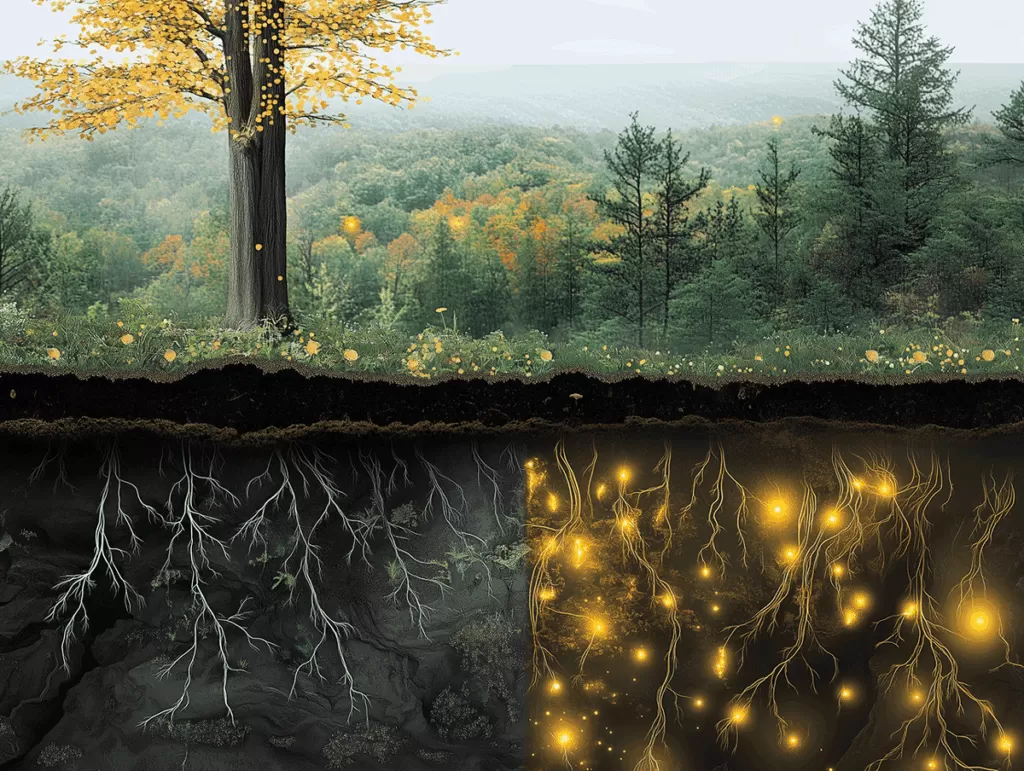
When one tree faces attack, the entire forest responds—neighboring trees shift resources, activate defenses, and adjust growth patterns through underground mycelial networks, demonstrating how authentic community shares intensities collectively rather than isolating individual struggles.
The Practice of Collective Response
When community members face difficulty, the mycelial model suggests moving beyond individual support toward what we might call “ecosystem response”—changes in the whole environment that address root conditions rather than just immediate symptoms. Grief as Network Teaching When someone in the community experiences loss, we create space for collective learning about impermanence, connection, the reality of endings. This isn’t about making meaning from others’ pain but about letting their experience teach the network something essential about living. Joy as Abundance Creation When someone celebrates achievement or breakthrough, we practice what ecologists call “positive feedback loops”—amplification that increases the system’s capacity for generating similar successes. Individual flourishing becomes community abundance rather than individual distinction. Growth as Edge Development When someone pushes into new territory—starting businesses, making art, exploring spirituality—we support not just the individual but the expansion of what’s possible within the network. Edge pioneers extend the community’s capacity for innovation. Uncertainty as Network Resilience When someone faces major transition or confusion, we practice collective presence with mystery rather than rushing to provide answers. The mycelium navigates uncertainty through increased communication and resource-sharing; communities can learn similar response patterns. This transforms what Han calls our culture’s “atomization” into what we might call “collective embodiment”—understanding that we literally become stronger together, not just psychologically but practically.The Seasonal Rhythms of Underground Networks
As we explore how mycelial wisdom applies to community building, we begin to glimpse something that points toward future investigations: the necessity of what we might call “contemplative seasons” in community life. The mycelium’s activity changes throughout the year—intensive growth periods, maintenance phases, storage times, what appears to be dormancy but is actually deep network strengthening. These rhythms ensure both immediate responsiveness and long-term resilience. Most modern communities operate at single speed: constant activity, regular meetings, consistent programming. But the mycelium suggests that sustainable community requires honoring different rhythms of connection—times for intensive collaboration, times for individual reflection, times for what Han calls “the art of lingering” without productive purpose.Preview: The Virtue of Community Wintering
This points toward questions we’ll explore in our future discussion of reflection and contemplation: How do communities create space for the kind of deep rest that strengthens rather than weakens connection? What does it mean to honor contemplative time as essential to community health rather than obstacle to community productivity? The mycelium maintains its networks through what appear to be dormant periods—times when above-ground activity stops but underground connection deepens. We might need similar understanding of how contemplative rest serves community formation in ways that constant activity cannot. For now, we can recognize that the most resilient communities create rhythms that honor both engagement and reflection, both collaborative intensity and individual processing time.From Network to Forest: The Ripple Effects of Mycelial Community
When communities operate like healthy mycelial networks—flowing resources without keeping score, sharing information without agenda, responding to stress through collective adaptation—something extraordinary happens. They become what ecologists call “keystone species”: relatively small groups that create conditions for much larger systems to thrive. Real community becomes a practice ground for ecological thinking in a culture obsessed with individual optimization. The principles learned in mycelial community ripple outward:- Gift economy practices challenge purely transactional relationships
- Network resilience offers alternatives to hierarchical organization
- Collective response models demonstrate how sharing intensities creates strength rather than depleting it
- Seasonal rhythms provide sustainable alternatives to constant productivity demands
The Underground Revolution
The mycelium performs what we might call “invisible activism”—transforming ecosystems through patient, persistent, underground work that creates conditions for life to flourish. Individual trees may get the visible credit for forest health, but scientists now understand that mycelial networks make forest resilience possible. Perhaps authentic community building works similarly: not through visible organizing but through underground relationship-building that creates conditions for collective thriving. This suggests that the most important community work happens in spaces our productivity culture overlooks—the quiet conversations, the unplanned check-ins, the shared presence that serves no function except strengthening the network. The mycelium is always teaching. The forest floor is always pulsing with connection we can learn to recognize. Maybe it’s time to stop building community above ground and start growing it from below. Maybe authentic connection isn’t something we create but something we join—the ancient network that’s been connecting life for millions of years. Maybe community isn’t a human institution but an ecological reality we can learn to inhabit more skillfully. The network is always present, always responsive, always creating conditions for life to flourish. The question isn’t whether sustainable community is possible—it’s whether we’re ready to recognize the connections that already exist and learn to participate more fully in the underground web that sustains everything.Resources for Mycelial Community Builders: Essential Reading:
- Entangled Life by Merlin Sheldrake
- Finding the Mother Tree by Suzanne Simard
- The Hidden Life of Trees by Peter Wohlleben
- Braiding Sweetgrass by Robin Wall Kimmerer
- The Gift by Lewis Hyde
- The Disappearance of Rituals by Byung-Chul Han
- Emergent Strategy by adrienne maree brown
- Sacred Economics by Charles Eisenstein
- The Art of Gathering by Priya Parker
- On Being: Parker Palmer & Courtney Martin discuss “The Inner Life of Rebellion”
- Layla F. Saad’s Good Ancestor Podcast
- Talks @ Google: “The Art of Gathering” by Priya Parker
- What would change if we approached relationships as participation in existing networks rather than creation of new connections?
- How might our gatherings shift if we designed them to strengthen underground bonds rather than produce visible outcomes?
- Where in our lives are we keeping score instead of trusting the natural circulation of gift and response?
- What would community building look like if we modeled it on mycelial networks rather than business organizations?