
Listen to the companion Sparks + Embers episode for this Kindling feature article below.
Expand from intimate family grammar to tribal leadership and stewardship that can preserve and transmit wisdom across generations
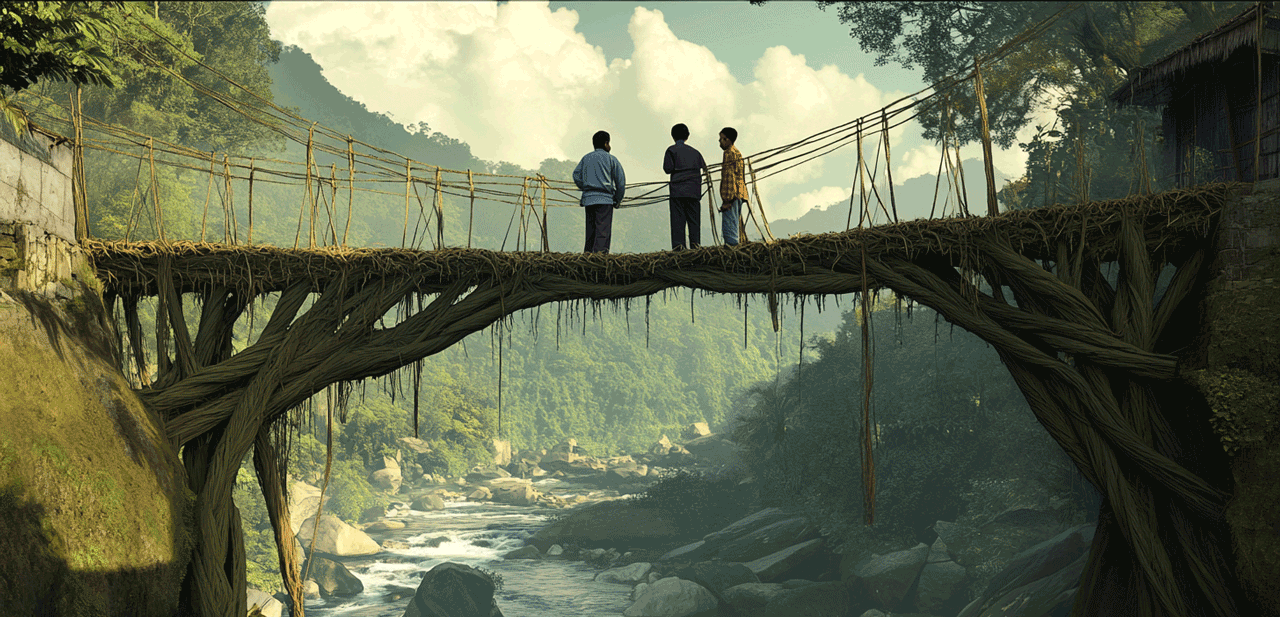
In Meghalaya’s Rangthylliang village, Morningstar Khongthaw faces an emergency that has nothing to do with monsoons or failing concrete. Twenty skilled elders remain who can teach the ancient art of growing living bridges. When they die, centuries of knowledge dies with them.
“Every monsoon, which is the prime season for weaving the young roots, groups of youths come together to apprentice under them,” Morningstar explains. But twenty teachers for an entire people. The math doesn’t work.
This crisis reveals something we’ve forgotten: family leadership grammar means nothing if the community cannot preserve and transmit it beyond individual households. We learned to speak leadership within families, but we need tribal fluency to survive.
The Territory We’re Entering: Tribal Scale Leadership
The Natural Unit of Complex Knowledge Transmission
Something changes when a group reaches 20 to 150 people. Everyone knows everyone else – not intimately, but well enough to stop and say hello on the street. Large enough for knowledge diversity, small enough for accountability. This size matters because complex knowledge like bridge-building requires multiple generations working together, more knowledge holders than any single family can sustain.
I watch this in my own life. My family taught me the basics of authority and collaboration. But the complex projects that matter – the ones requiring patient cultivation across decades – these demand tribal support. When my family moved away from our extended community, I lost access to the wisdom-keepers who could have taught me things my parents never learned.
The difference between tribal influence and family influence is the difference between institutional memory and intimate formation. Families teach us the grammar of relationship. Tribes determine whether that grammar serves something larger than ourselves.
What Dies When Tribes Fail
The bridge-building knowledge represents a particular kind of wisdom that can only exist at tribal scale. Individual families can teach patience, but only communities can sustain projects spanning multiple lifetimes. Single households can model collaboration, but tribal-level coordination requires systems thinking that exceeds nuclear family capacity.
Watch what happens when this knowledge transmission breaks down. In Meghalaya, younger generations migrate to cities for education and careers. They return with engineering degrees but without the patient presence required to guide rubber tree roots across impossible gaps. The formal credentials don’t include the seasonal rhythms, the community trust-building, the seven-generation thinking that makes living bridges possible.
We face the same pattern everywhere. Families produce individuals skilled in leadership basics, but without tribal support, that leadership remains individual-focused rather than community-serving. We excel at personal development but struggle to create systems that regenerate wisdom across generations.
The Contemporary Crisis: Scattered Tribes
Modern life scatters the natural groupings that sustained complex knowledge. Geographic dispersion separates us from extended wisdom-networks. Digital pseudo-communities provide connection without the sustained presence complex learning requires. Institutional structures substitute bureaucratic hierarchy for the ecological relationships that enable genuine knowledge transmission.
We’ve gained efficiency and lost depth. The institutions that replaced tribal learning – schools, corporations, professional associations – excel at information transfer but struggle with wisdom cultivation. They can teach techniques but not the deeper patterns that make techniques serve human flourishing.
The result: we find ourselves hungry for the very community structures our mobility and success have rendered difficult to sustain.
"Leaders exist to serve collective flourishing, not to accumulate personal power. Decision-making involves consensus-building rather than top-down directives."
The Five Stages of Tribal Culture: Mapping Where Communities Stand
Stage Assessment Through Language and Behavior
We can assess tribal health by listening to the language people use when nobody important is watching. The words reveal the underlying assumptions about how life works and what’s possible.
Tribal cultures evolve through five developmental stages outlined by Logan, Fischer-Wright, and King (Tribal Leadership model)
Stage 1 (“Life Sucks”): Communities trapped in despair. Individual survival trumps collective wisdom because people believe the system itself is broken. I recognize this from neighborhoods where everyone competes for scarce resources and nobody trusts that cooperation could change anything fundamental.
Stage 2 (“My Life Sucks”): Passive-aggressive communities where people blame external circumstances while avoiding ownership of their part in creating change. These groups generate victim narratives that prevent the agency wisdom transmission requires.
Stage 3 (“I’m Great”): Individual achievement cultures where people excel but undermine collective knowledge-keeping. I see this in professional environments where talented people hoard information to maintain competitive advantage rather than circulating wisdom for everyone’s benefit.
Stage 4 (“We’re Great”): Collaborative communities united by shared values and common purpose. Information flows. People link their individual development to collective flourishing. These communities can sustain multi-generational projects because success means “we all get better together.”
Stage 5 (“Life is Great”): Transcendent communities focused on legacy beyond their own success. The bridge-builders who start projects their great-grandchildren will complete. These groups operate from abundance rather than scarcity, contribution rather than accumulation.
The Bridge-Builder’s Dilemma: Individual Excellence vs. Collective Wisdom
Stage 3 communities create a particular trap. They reward individual mastery but punish the knowledge-sharing that makes collective wisdom possible. I’ve worked in organizations that celebrated high performers while undermining the relationships those performers needed to develop others.
The bridge-builders face this dilemma constantly. Training gifted individuals in complex techniques while ensuring knowledge spreads throughout the community. Too much focus on individual excellence and wisdom becomes isolated. Too little and the techniques themselves deteriorate.
Stage 4 communities solve this through invisible activism where patient relationship-building creates underground networks of mutual support. People develop excellence not for personal advancement but as contribution to collective capability. Individual mastery serves community resilience.
Stage 5 communities transcend the dilemma entirely. Excellence and succession become the same project. People develop skills knowing their primary job is developing others who will surpass them. The bridge-builders who measure success not by spans completed but by young people capable of growing bridges they never imagined.
Personal Recognition: Where Do I Find Myself?
I catch myself defaulting to Stage 3 thinking when pressure mounts. Protecting my expertise rather than sharing it. Competing for recognition rather than building capacity in others. The pattern is subtle but unmistakable: when I prioritize looking good over creating conditions where others can flourish, I’ve slipped out of tribal leadership thinking. I am failing the bi-directional test of being master and apprentice at the same time..
The transition from family loyalty to tribal stewardship requires this kind of honest self-assessment. Family patterns prepared me for intimate relationships but not for the broader responsibility tribal leadership requires. Moving from “how do I serve my family?” to “how do we serve something larger?” demands different muscles.

Indigenous Wisdom: Models That Actually Work
The Seven Generations Principle in Practice
Multiple indigenous groups have included legacy requirements in their governing documents for mentoring and leadership. A common requirement stipulates decisions must consider impact seven generations into the future. Not next quarter or next election cycle. Seven generations. 150 years ahead.
When the bridge-builders plant Ficus saplings, they think in these time scales. The person who guides a root system today may never see the completed span. But they act from certainty that future generations will benefit from work they’ll never experience.
This temporal perspective transforms every leadership decision. Instead of optimizing for immediate results, you optimize for antifragility – the capacity to get stronger under stress over time. Instead of building systems that depend on current leadership, you create systems that regenerate leadership across centuries.
I practice this by asking: “Will this decision seem wise from the perspective of seven generations?” The question eliminates most opportunities, which concerned me. But the projects that pass this filter tend to energize rather than drain me. They connect with something sustainable in my motivation structure.
Community-First Leadership Patterns
Indigenous leadership models challenge our assumptions about individual authority. Leaders exist to serve collective flourishing, not to accumulate personal power. Decision-making involves consensus-building rather than top-down directives. Cultural safety creates environments where knowledge can be shared without exploitation.
Elder councils demonstrate how wisdom-keepers guide without dominating. Elders provide perspective and historical context while younger people contribute energy and innovation. The system honors both continuity and adaptation.
Consensus building reveals the difference between democracy and indigenous consensus. Democracy often means majority rule with minority accommodation. Indigenous consensus means continuing conversation until everyone can live with the decision, even if they wouldn’t have chosen it independently.
Cultural safety protects the conditions where vulnerable knowledge-sharing becomes possible. People need to trust that their contributions won’t be used against them or appropriated without acknowledgment. This requires community agreements about how knowledge circulates and who benefits from its application.
Bridge-Building as Seven-Generation Practice
Indigenous models demonstrate how sustainable leadership succession works across generations. Not through formal training programs but through embedded relationships where wisdom transmission happens within the context of real work.
The integration of individual development with collective responsibility provides a template for contemporary application. Rotational leadership based on expertise and calling rather than hierarchy. The role of ceremony and ritual in knowledge transmission.

The Underground Networks: How Real Influence Flows
Mycelial Leadership Patterns
Parker Palmer writes about community as gift to be received rather than product to be manufactured. This shifts everything. Instead of trying to create community through events and programs, we learn to recognize and nurture the underground networks that already exist.
I watch this in the spaces between formal organizational structure. The informal conversations where real decisions get made. The relationships that survive institutional reorganizations. The people others turn to when they need actual help rather than official assistance.
Authentic tribal leadership operates through invisible activism – transforming ecosystems through patient, persistent, underground work. Not the visible leadership that generates recognition but the relationship-building that creates conditions where others can flourish.
This requires different measures of success. Instead of counting followers or tracking metrics, you attend to the health of the networks themselves. Are people becoming more capable? Do they turn to each other for support? Can the system adapt to change without leadership intervention?
Moving from Surface-Level to Underground Connection
The difference between networking events and tribal knowledge-sharing is the difference between transaction and transformation. Networking seeks immediate benefit from connections. Tribal development invests in relationships that strengthen under pressure.
Building non-transactional relationships in transactional cultures requires patience. You offer support without expectation of return. You share resources based on need rather than reciprocal exchange. You invest presence rather than accumulating contacts.
This challenges every efficiency model I learned in professional contexts. But the relationships that survive this approach become the infrastructure for everything else that matters. When crisis hits, people know who to call. When opportunity emerges, resources flow to where they can have most impact.
The Challenge of Leading Tribal Transformation
Individual achievement motivates Stage 3 leaders to avoid tribal responsibility because tribal development requires sharing power rather than accumulating it. Stage 4 leaders learn to circulate power rather than hoarding it – creating conditions where authority emerges from competence rather than position.
The sacrifice required: personal advancement for collective stewardship. This doesn’t mean self-denial but redefining success in terms of what you enable rather than what you achieve. The bridge-builders who measure impact not by spans they complete but by communities capable of growing bridges without them.

Contemporary Applications: Building Modern Tribes
Creating Tribal Culture in Institutional Settings
Palmer suggests creating “pockets of possibility” within bureaucratic structures. Places where people can live and work differently than the organizational chart dictates. Not transforming entire institutions but creating spaces where tribal principles can operate within larger systems.
I’ve seen this work in organizations that create apprenticeship relationships despite formal hierarchies. Teams that develop gift circulation patterns within competitive environments. Groups that practice seven-generation thinking even when institutional pressure demands quarterly results.
The key is starting small and building. Tribal culture can’t be imposed from above but it can be modeled from within. People recognize authentic community when they experience it and become curious about how to create similar conditions in their own spheres.
The Digital Challenge: Real vs. Pseudo-Community
Digital connection supplements but cannot replace embodied tribal learning. Virtual relationships lack the full presence complex knowledge transmission requires. But technology can support tribal gathering when used strategically.
The most effective digital tribal development I’ve witnessed uses technology to coordinate embodied gatherings rather than substituting for them. Online spaces that facilitate real-world meetups. Digital tools that help people find their tribes rather than replacing tribal interaction with screen-mediated connection.
Scale presents another challenge. When communities become too large for tribal dynamics, they need federation structures that maintain tribal-scale sub-units while enabling larger coordination. The bridge-building communities that network individual villages while preserving local knowledge-keeping.
Practical Tribe-Building Strategies
Start with gift circulation experiments. Practice offering support without expectation of return. Notice opportunities to share resources based on need rather than reciprocal exchange. Build relationships that strengthen under pressure rather than dissolving at first difficulty.
Seasonal rhythms create ceremonial containers for knowledge transmission. Regular gatherings focused on learning together rather than consuming information. Times for sharing wisdom, practicing skills, acknowledging growth, marking transitions.
The progression Parker Palmer outlines applies: recognizing community as gift rather than product, cultivating capacity for connectedness, creating trustworthy space where resourcefulness can emerge.
The Flow Principle: When Tribes Become Stuck
Developmental Bypass at Tribal Scale
Jumping to Stage 4 (“We’re Great”) without developing individual competence creates communities that feel good but lack effectiveness. Groups that emphasize collaboration while avoiding the skill development that makes collaboration productive.
Staying stuck in Stage 3 individual achievement when tribal stewardship calls creates talented people who struggle to work together. Entrepreneurs who build successful ventures but can’t create systems that function without their constant intervention.
The cost of tribal stagnation: knowledge dies because no one takes responsibility for preservation and transmission. Bridges don’t get built because individual excellence never matures into collective capability.
Building Tracks for Future Tribal Leaders
Creating systems that support others’ development rather than just personal advancement. The transition from being tribal members to tribal mentors. The bridge-builders who understand their primary job is developing people capable of building bridges they never imagined.
This requires infrastructure thinking – considering not just immediate projects but the capabilities those projects develop in others. Each bridge becomes a training ground. Each challenge becomes a development opportunity. Each success becomes a teaching case.
When Individual Growth Serves Collective Flourishing
Resolving the false choice between personal development and tribal loyalty requires understanding how individual mastery enables collective contribution. The bridge-builders who develop expertise not for personal advancement but as service to community need.
Moving beyond tribal narcissism to engagement with larger systems. Tribes that serve their own members while contributing to broader ecological and social health. Local wisdom that enriches rather than diminishes global understanding.
Questions for the Bridge-Building Journey
We gather to preserve knowledge that individual families cannot hold alone. The bridge-builders face the same challenge we all face: how to maintain wisdom across generations when the world keeps changing faster than institutional memory can adapt.
The stage of tribal culture that characterizes the communities where we invest time and energy shapes everything else. Underground networks operating through patient relationship-building create different possibilities than surface-level connections focused on immediate exchange.
Serving immediate tribal needs while building bridges we’ll never cross ourselves requires the seven-generation thinking that indigenous communities have practiced for centuries. Making leadership decisions that consider impact 150 years from now changes every choice we make today.
Tribal leadership prepares us for professional and societal influence. Understanding how individual excellence serves collective stewardship. Learning to circulate power rather than accumulate it. Developing the complexity needed for institutional change.
Next month we’ll explore how tribal wisdom transfers to professional contexts: bringing apprenticeship principles into organizational life shaped by credentialist assumptions. How do we maintain bridge-building wisdom when operating within large-scale systems designed for quarterly results rather than generational impact?
Until then, may we learn to recognize the tribes we already belong to and the wisdom we’re responsible for keeping alive.
Research References
Allen, K. (2023, December 15). The seventh generation principle. Dr. Kathy Allen. https://drkathyallen.com/the-seventh-generation-principle/
Finn, S., Herne, M., & Castille, D. (2017). The value of traditional ecological knowledge for the environmental health sciences and biomedical research. Environmental Health Perspectives, 125(8), 085006. https://www.ncbi.nlm.nih.gov/pmc/articles/PMC5783664/
Girard, G. (2017, November 28). Tuesday tips: The five stages of tribal leadership, presented by Spin Ultimate. Ultiworld. https://ultiworld.com/2017/11/28/tuesday-tips-five-stages-tribal-leadership-presented-spin-ultimate/
Isaac, G., Finn, S., Joe, J. R., Hoover, E., Gone, J. P., Lefthand-Begay, C., & Hill, S. (2018). Native American perspectives on health and traditional ecological knowledge. Environmental Health Perspectives, 126(12), 125002. https://www.ncbi.nlm.nih.gov/pmc/articles/PMC6371761/
Leimer, A. D. (2015). Measuring a Cognitive Apprenticeship Model of Instruction in Statistics Education [Doctoral dissertation, University of Southern Mississippi]. Digital Commons Network. https://aquila.usm.edu/dissertations/98
Mahegun Tails, Inc. (2024, November). Nine principles of Indigenous mentoring. https://hub.albertamentors.ca/wp-content/uploads/2025/02/Nine-Principles-of-Indigenous-Mentoring-F1.pdf
Metzger, D. C. H., Earhart, M. L., & Schulte, P. M. (2024). Genomic and epigenomic influences on resilience across scales: Lessons from the responses of fish to environmental stressors. Integrative and Comparative Biology, 64(3), 853–866. https://www.ncbi.nlm.nih.gov/pmc/articles/PMC11445785/
Miemis, V. (2012, June 28). A step-by-step guide to tribal leadership: Part 1: The five stages of tribal culture. emergent by design. https://emergentbydesign.com/2012/06/28/a-step-by-step-guide-to-tribal-leadership-part-1-the-five-stages-of-tribal-culture/
Rousseau-Thomas, J. (2023, June 05). Thinking differently: Using the Seven Generations Principle. Generation Squeeze. https://www.gensqueeze.ca/thinking_differently_using_the_seven_generations_principle
Sanchez, J., Maiden, J., Barton, E., Walters, L., Quinn, D., Jones, N., Doyle, A. K., & Lim, D. (2023). Factors that sustain indigenous youth mentoring programs: A qualitative systematic review. BMC Public Health, 23(1), 429. https://www.ncbi.nlm.nih.gov/pmc/articles/PMC9987150/
Stalmeijer, R. E., Dolmans, D. H. J. M., Wolfhagen, I. H. A. P., & Scherpbier, A. J. J. A. (2009). Cognitive apprenticeship in clinical practice: Can it stimulate learning in the opinion of students? Medical Teacher, 30(4), 535–546. https://www.ncbi.nlm.nih.gov/pmc/articles/PMC2744784/
Vandyck, C. K. (2023, August 16). Embracing Indigenous Leadership Models for Africa’s Development Renaissance. WACSI. https://wacsi.org/embracing-indigenous-leadership-models-for-africas-development-renaissance/
Whitworth, E. (2022, July 20). Tribal leadership stages: How culture develops. Shortform Books. https://www.shortform.com/blog/tribal-leadership-stages/
Disclosure Statement
This post was produced according to the approach outline in The Art of Transparent AI Collaboration Workflow (click to review).